
The Casting Couch
by Neal Auch
“How old were you when you lost your virginity?”
“Thirteen.”
“Tell me about that experience.”
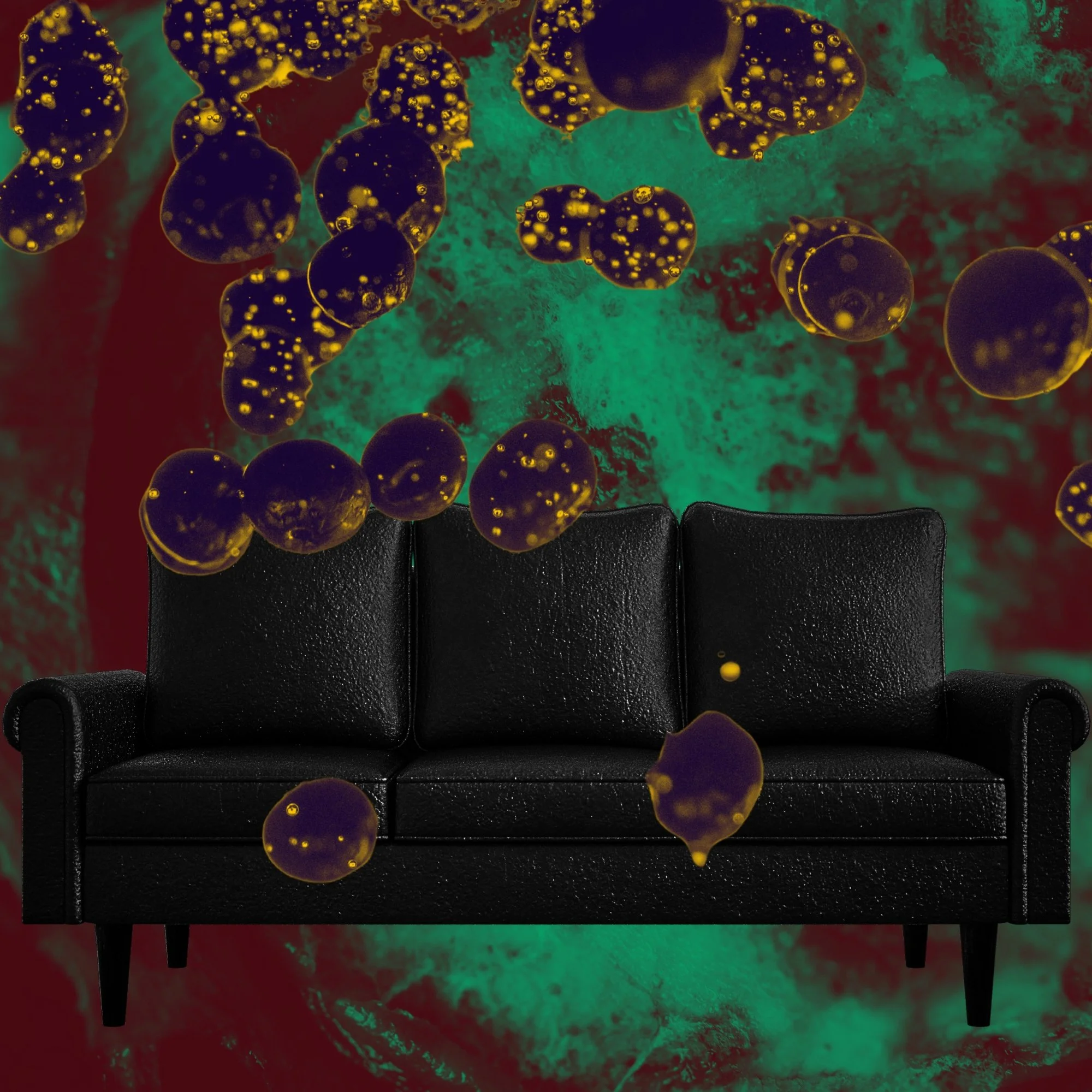
She told her story—some convoluted lie about stolen glances, unkept promises, fumbling hands. She told her story to the stained couch, the pre-framed department store wall art, the segmented bodies skittering about in the darkness behind his office walls. And as she spoke he let the camera pull in close, pan down to the hem of her skirt, linger on the flash of red lingerie peeking through folds of plaid.
“What I do is I get girls like you jobs,” he said. “These jobs pay one thousand to five thousand dollars per day, depending on who you work with and what you do.”
He spoke with the cadence of a waiter reciting the day’s specials.
“This is a demo tape we’re making,” he said. “I send the tape off to producers and if they like what they see they’re going to hire you. And you’re going to get paid one thousand to five thousand dollars per day. All you need is my recommendation. So I’m the guy you need to impress if you want to get paid.”
“I really want this job,” she said. “I really, really want this job.”
She let her attention drift from the camera lens to the counterfeit designer handbag perched on the couch next to her. She hadn’t been able to close the zipper with the bowie knife in place and now, with the lights on and the camera rolling, she wondered if the butt of its handle might be visible from his vantage point. She looked away—his eyes might follow her own.
“It sounds like you’re the kind of girl I want to hire.” He slouched back in his office chair, pulled the tab on a canned energy drink, let the sugary syrup pass his lips. “But I can’t just hire a pretty face, you understand. The producers need to see what you look like naked.”
A few moments of feigned surprise, feigned reluctance, and she took her place by the wall. And together they went through the motions. The man ferried his tripods and softboxes into position. And the woman unbuttoned her blouse. And neither paid much attention to the other. Nor to the room—the office—even though it was alive. Neither listened to the sound of the ducts rattling or the pipes groaning or the fluorescent bulb, buzzing away in its compartment above them. And neither heard that other sound, altogether less familiar, sputtering and gasping beneath the bulb’s electric drone. It was a wet sound, like the note a chicken carcass plays when the esophagus is released, finally, from the sleeve of the neck.
“What size are those?” he said.
“Now bend all the way over and touch your toes,” he said.
“I’m going to need to you to spread your cheeks for me,” he said.
The line of sight between them was broken by the DSLR, the 35mm glass, the digital viewfinder. Inside the machine, tiny servos pulled focus on folds of soft tissue, pale and goose-bumped and trembling.
He paused for a sip from his energy drink.
“The producers are going to need to see that you can work with a male talent,” he said. “Today that’s going to be me.”
“Are you serious?” She looked down and to the left, covered herself with her hands as best she could. “I thought I was just coming here for an interview. I didn’t think we were doing a scene today. Shouldn’t I be getting paid if we’re doing a scene? Do I really have to do this?”
“You’re not getting paid today. Think of this like a job interview. If you want to get hired in the industry then you’re going to need a demo tape where you work with a male talent. And I’m the guy who makes that happen. If you want to make one thousand to five thousand dollars per day, you’re going to have to show the producers you’re willing to go that extra mile.”
The sound grew louder. She could hear it echoing from behind the walls: tissues being rearranged, bladders filling and draining, fluids intermingling. She could hear the creak and moan of the drywall buckling under the pressure. She closed her eyes. Dark stains blossomed around the electrical outlets, the ethernet plug, the light fixtures.
“Okay,” she said.
She opened her eyes again.
Her temples throbbed.
“I mean, I guess that’s okay,” she said. “I really need this job. I’m behind on my rent and my grandmother is sick and I can’t pay my bills and I might have to drop out of school and I can’t afford to send my puppy to the vet.”
“It’ll be easy, trust me. Just turn off your brain. I’ll lead and you follow.”
She listened, smiled, did as she was told. And when the cameras were in place she fell to her knees, like Sunday, before him. He fumbled with his belt and she let her eyes drift to the handbag, still perched on the nearby couch. The zipper was undone. The polished walnut handle protruded from the ragged closure.
“This tape is only going to the producers though, right? Nobody else will ever see this, right? I’m just a little worried… I could lose my scholarship if this tape ended up on the internet…”
“It’s going to be fine,” he said. “I promise you.”
“You wouldn’t ever lie to the girls who come through here, would you?”
“The talking part of the interview is over.”
He freed himself from the confines of his boxers, pale flesh unfurling like a tapeworm on the dissection table. Her temples throbbed. And her hips buckled slightly beneath her. She was unsteady in the kneeling position—an old skiing injury flaring up, perhaps. She balanced herself against the couch, let one arm rest on the cushion next to her open handbag. Her fingers grazed the polished walnut.
The dark stain above them was growing, spreading shapelessly from the boundaries of the light fixture out toward the walls.
She opened her mouth.
And as the pixelated pale thing in the viewfinder gagged and choked and spat, a few drops of something viscous escaped from the saturated ceiling panel above them. And it dripped down onto her, rivulets of black sludge tracing complex trajectories across her face and chest and stomach. She sputtered and tumbled back onto her heels.
“This wasn’t in the fucking script, Eric,” she said. “You can’t just change the scene on the fly like that.”
She collected her panties from the crumpled pile beside the couch, cleaned her face as best she could.
“I never agreed to viscous black sludge,” she said. “I charge extra for viscous black sludge.”
“No, no, that’s not what this is. This isn’t the scene.” He fumbled to pull his chinos up over his failing erection. “Viscous black sludge?”
“Viscous black sludge, Eric. I charge extra for viscous black sludge.”
“That’s not what this is…” His eyes traced a line from the black puddle on the carpet below him to the discoloured ceiling tiles above. “There’s something wrong with the building, the plumbing. I don’t know. I think we probably need to leave. I don’t think it’s safe for us to be here.”
He dressed, made for the office door.
She stayed behind, naked. She traced the walls of the office, studied the fracture lines, the black stains, the delicate tendrils snaking through the fibres of the carpet.
The door handle turned easily under his grip. And he could hear the latch sliding back and forth, in and out of its slot in the door frame. But the hinges did not give. And the door would not budge.
“It doesn’t work,” he said. “This is insane, why doesn’t it work?”
“Try this. Maybe you can pry it open.” She drew the bowie knife from her handbag and tossed it to him. “I don’t imagine it’ll help. But you can try.”
He closed his tacky fingers around the walnut handle, unsheathed the blade.
“Jesus Christ,” he said. “You brought a knife with you to a porn shoot?”
“It’s the middle of the night, isn’t it? And you bring me out here, to some nondescript office building near the Scottsdale airport. You bring me out here in the dark. And I park my car in a lot where stinknet blooms through the crumbling asphalt.”
“I’ve just never had a girl bring a knife to a porn shoot is all.”
“There are dark corners in that parking lot.” She took her spot in the centre of the black leather couch, tucked a wisp of blond behind her left ear. “Believe me, Eric, every girl you’ve ever worked with has brought a knife to her shoot.”
He wedged the blade between the door and the frame, threw his weight against it. Wood strained, splintered. But the door did not budge.
“You can try the phones, the computer” she said. “You can cry out for help. I don’t imagine it’ll help. But you can try.”
He did. He cried out into the walls, the door, the dead landline, the dead cellphone. He pounded an impotent fist on the keyboard of the dead laptop. He cried out to the black stain on the ceiling, the growing puddle beneath it. He paced the room, prodded the knife point here and there at fixtures, vents, baseboards.
“Maybe there’s some other way out of here,” he said. “Maybe there’s something with the ducts, somehow. Maybe there’s some kind of crawlspace.”
“You don’t imagine they’d make it so easy as that, do you?”
“What is this?” He paced the room, shook his head. “How is this possible?”
“Every girl you’ve ever worked with has brought a knife to her shoot, Eric.”
She propped her heels on the leather cushion, spread herself wide.
She watched the walls.
And the office oozed black sludge from every crevice, every outlet, every wound. It pooled in the centre of the room, ankle deep. It teemed with life: tiny things, worm-like, always swelling and contracting, always moving. As much as the office and the sludge were alive, the things within them were also alive. She wondered what she would find if she carved away inside their tiny wriggling bodies, probed their warm interiors. More of the same, no doubt. No doubt it’s just circles of flesh nested endlessly within one another, each level feeding off the one above it, shitting down onto the one below. It’s parasites feeding on parasites feeding on parasites, she thought. The world is parasites all the way down.
Now the wet sound of flesh sloshing behind the walls was overwhelming. And there were voices, also. Guttural voices whispering empty promises to one another.
She could smell them through the walls—that familiar sear of ammonia in her sinuses.
The man retreated back to the couch next to her.
She touched herself.
And together they watched the set dressing fall away. The cameras and tripods and softboxes went first. And soon the set walls, also, with their gaudy pre-framed department wall art, unwound and dissolved and faded into the darkness of the sound stage. And all that remained was the couch and the couple perched upon it, pale and quivering. And above them the only light source—the fluorescent bulb now dangling in the void—threw its sputtering light down onto the humans and onto the things which had once been hidden. She studied them, scrutinized their strange anatomy. Their bulbous heads seemed so tenuously perched atop their long, slender trunks. She watched them rub against one another, muttering and groaning. The churning mill of their bodies extended indefinitely into the dark expanse of the soundstage.
The creatures kept their distance, for a time. For a time they lingered in the shadows. Sometimes one would break away from the pack and approach the couch. They came forth like maggots, she though, extending their soft bodies into slender tendrils and finding purchase on the carpet with their teeth before contracting again, drawing themselves forward. But even those few creatures brave enough to cross the threshold would not linger too long under the glow of the fluorescent bulb; after a few heartbeats each would inevitably retreat back into the mess of flesh. They were going through the motions, she understood. They were feigning fear, feigning reluctance. She knew that the performance wouldn’t last long. The climax had already been written.
The man beside her unsheathed the bowie knife, held it at arm’s length. The point trembled like a dowser’s wand, dancing from one creature to another. She drew herself close to him, put her lips next to his ear in order to be heard over the orchestra of flesh.
“How old?” she said.
“How old were you when you lost your virginity?” she said.
“Tell me about that experience,” she said.
And out there, in twilight region where fluorescent bulb’s feeble halo gave way to the darkness of the sound stage, something flipped. There was some subtle shift in the dampness of the air, the smell of their exhalations, the cadence of their voices. Or, perhaps, it was something deeper than that—something inside, in the soft inner parts we all keep hidden from the world. She couldn’t have said for sure. But she felt it all the same. The front of writhing creatures moved closer, drew up against the foot of the couch. And there, up close, she could scrutinize the contours of their bodies more carefully. Up close she could see what the distance had hidden: the sparse wiry hairs, the ridges and folds of semi-translucent skin, the baroque inner landscape of pulsing organs and hungry parasites.
She slid another finger inside herself.
The man wiped his damp palms on his chinos in order to improve his grip on the knife. But, in the end, he would not wield the weapon. When the climax came he buried his face in the cushion, blinded himself to their frenzy, the weight of their hunger, the blur of flesh. In the end, he couldn’t stomach for the beauty of it all.
The creatures were gone long before he found the courage to open his eyes again.
The girl was gone as well.
And he was left there, alone on the couch, alone under the faltering light of the fluorescent bulb. And beyond the perimeter of the casting couch there was nothing—only echoes. He might have searched for her. He might have set out into all that cold and all that dark. But she had left her stain on the couch and he was bound to it—even long after the taste had faded.
And he spoke. He told his story to the bulb, to the couch, to the feral things skittering about in distant places. The bulb sputtered and flickered, strained against the encroaching darkness. He let his tongue glide across the seams of the cushion, the pores of the leather, the ridges and folds.
In time he would wear it down.
In time he would find his way to the soft interior.
Neal Auch is a writer and visual artist. He is the author of two fine photography art books, including his grim reinterpretation of Golden Age still life: All is Vanity (2025). Auch's short fiction has been published in a variety of markets, including Nightmare Magazine, Skull & Laurel Magazine, and Three-Lobed Burning Eye. His nonfiction essays run the gamut from media analysis to art history to personal essay; these have appeared in Nightmare Magazine, Seize the Press, The Deadlands, The Canadian Medical Association Journal, and elsewhere. Auch's recent explorations into the world of smut can be found at arthousesmut.com.