
The L-Shaped Café
by Stephen Myer
The old man’s skin is pale in the flickering light, the texture of worn parchment. Dark glasses turn his wrinkled face into that of a desiccated bug. His body could crumble at any moment from the shaking of the train. If not for the furry tufts pulsing from his sunken nostrils, I would have taken him for a corpse. Other than his vile appearance, he has done nothing to offend me. Yet I want to crush him, that insect pretending to be a man. Hatred invites Nausea, my Dark Muse. She kneels before me, then slides her tongue along my thighs and stops to gnaw at my gut. It is the worst kind of sex.
The old man grins and I thoughtlessly return the gesture. He raises his hands, tapping the air with trembling fingers as if typing a document on which our smiles become our signatures—an agreement whose terms and conditions are known only to him. He taunts me with audacity. Oh, to leap across the aisle, rip it from his hands and read what he’s duped me into signing—but Nausea is a cruel mistress who has pinned me to my seat.
The door between the subway cars slides open and a woman appears. She drifts along the aisle in scarlet beauty. Her auburn hair sways above the collar of a rosy blouse that flows into a crimson skirt. It matches her lips and fingernails. Maroon stilettoes sculpt the perfect contours of her legs. She sits opposite me, a masterpiece in red, but so close to the insect man that their bodies touch. The sight disgusts me. I envy him.
Like the old man, her eyes are hidden behind dark glasses. She adjusts her skirt, exposing more of her legs, then raises an eyebrow and pouts. She flirts while Nausea abuses. Don’t lose the scarlet woman you could love, I tell myself—but it’s no use. Steel wheels screech like swine to slaughter as the train enters the station. Nausea stands. Her hands tighten around my neck and drag me out the door. On the platform, she flings me against a wall. I pull my hair back to retch, then slide down beside a puddle of myself on the filthy concrete floor, watching the train depart with the woman I could love.
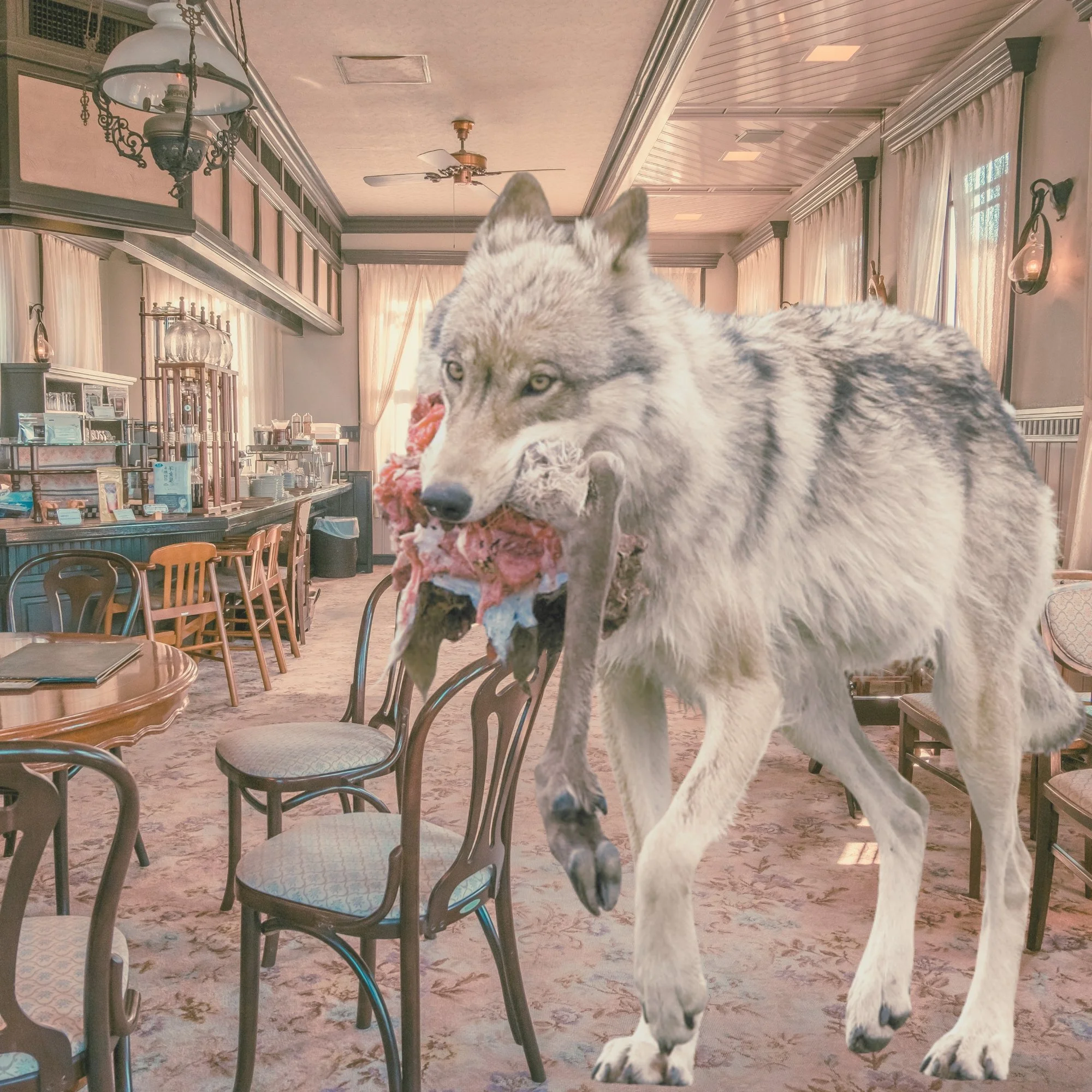
The electric smell of the underground stings. Nausea and I trudge through the faceless crowd and climb the stairs leading to the scorched surface of the city. It has never been this hot. As we pass through rippling waves rising from the sidewalk, I smell the musky scent of the Wolf. Maybe the rattling of the train woke him. My head pounds as he stretches his legs, kicking and clawing the inside of my skull. Saliva drips off his tongue and trickles from the sides of my mouth. The dried blood beneath his lupine nails liquefies, then drops and sizzles on the blazing pavement—a reminder of what I have done.
“Please stop!”
Nausea consents. The Wolf refuses. He stands erect and snarls, then marks his territory by plunging his teeth into my soul.
* * *
The drone of the overhead fan soothes me and I no longer expect the unexpected—calm, even giddy, standing in line, waiting to be served at the café. Then, a tap on my shoulder.
“We met on the train.”
It’s a deep, luscious voice. I turn to find the woman in red. In my stupor, I can’t think of anything to say except she must have mistaken me for someone else.
“I don’t think so, and neither do you,” she says. “What do you recommend?”
“Recommend?”
“For this unbearable heat. You haven’t cornered the market on suffering.”
There are no signs of perspiration on her skin or clothing. “Well?” she demands.
“A cup of hot ginger green tea.”
“Why on Earth would I want that?”
She is aggressive and requires an account of everything. This woman is different from the others, perhaps a hallucination or a grateful gift from Death for my recent donation.
“The tea is what you need, not what you want. Wander through shady green forests and breathe the pungent scent of ginger drifting along an evening breeze, served scalding to cauterize your wounds.”
She stares at me so oddly that I am ready to sign an affidavit attesting to my madness. Maybe I already have—on the train with the old man.
“This magical potion you speak of sounds delightful if you’re a masochist,” she says. “What makes you think I’m wounded?”
“Everyone is. We’re all creatures of the paradox.”
“I see. So, this tea will cure me?”
“May I help you?” interrupts the attractive barista.
“Two cups of ginger green tea.”
“Great choice. Your name?”
“Martin.”
“Hi, I’m Eve.” She gives me a genuine smile and points to her nametag. “Just like it says.”
The barista seems pleasant and she has beautiful eyes—but her strident voice is painful. It’s enough to discourage any romantic notion. I turn to the woman in red. She has disappeared, again. About to bolt from the counter and track her down, I see her crimson fingertips waving near a table at the far end of the L-Shaped Café. The barista taps my arm to reclaim my attention.
“I heard your description of the tea. It was like poetry,” she says in her grating voice. “I think you and your lady friend will love it.”
Please stop talking, or ...
“Nice to meet you. I’ll call your name when the order is ready.” The conversation mercifully ends.
The woman in red leans her bag against the wall and slides onto the chair.
“Thank you, Martin.”
“How do you know my name?”
“You gave it to the friendly barista. I’m Cassandra Hayes.”
“Martin Morse.”
Her arm extends in an elegant arc. I reach for her hand at the exact moment Eve Interruptus shouts: “Martin. Come and get it.”
My head aches; my ears ring as I carry the drinks back to the table. Is it the Wolf, again? Maybe an aftershock of the barista’s voice. I grimace. Cassandra asks me if I’m all right.
“Had a migraine this morning. I guess it’s not finished with me yet.”
The pain fades as Cassandra gracefully raises the cup to her lips. The scent of the tea sweeps her away, and she likely doesn’t suspect I’m lying about the reason for my distress. Looking up, she catches my stare.
“What’s wrong?” she says.
“Nothing. Just admiring you.”
She sits frozen in her chair.
“Sorry. I didn’t mean to sound forward.”
She returns to the brew, letting it swirl around her tongue before swallowing. The steam creeps up her glasses and I no longer see my reflection.
“This is delightful. Martin, you’re a genius,” she says between parenthetical dimples.
“I’m just a normal guy trying to survive.”
“Oh, please. No one is normal and no one survives. I’m sure you agree. Look, honesty is the rule with me. How about you?”
“Sure.”
“Then we have an understanding. Let’s chat. You go first.”
“Where should I start?”
“With today. No need for an autobiography.”
“Fine. First, a question. That old man on the train—do you know him?”
She lowers her teacup. “What an odd thing to ask.”
“Why pick that seat next to him? He seemed so creepy.”
“It gave me the best view. You looked so handsome in your pain.”
My affliction appeals to her. I note her reply and make no further inquiries.
“Anyway, about my day,” I say. “I took the subway from The Tropic of Loneliness. It was so hot on the train I decided to stop at the café and—”
She interrupts. “This Tropic of Loneliness sounds inviting, like some secret part of the world. How did you find it?”
She doesn’t ask what it is, though she seems interested in going there.
“A fair question. I wouldn’t expect a beautiful woman like you to suffer the sickly pangs of the forlorn. It’s a place in the city where people get together to work through their … loneliness.”
She peers over her glasses. I can't see her eyes in the dim light of the café. “Loneliness is not a sickness,” she insists. “It’s a condition—brought on by others. I have every right to suffer as much as you.”
I let it slip out that Ingret was beautiful, but lonely enough for both of us.
“Who’s Ingret?” she asks.
“She’s my ... was my wife. That’s not to say she didn’t deserve what she got.” I am careless with my words.
“Ooh. This is getting interesting,” says Cassandra.
Part of me wants to confess everything. “I’m glad to be rid of her. She made life Hell.”
“What did she do, if you don’t mind me—?”
“Let’s just say she laid her eggs in other birds’ nests. Ingret lied, even when I caught her in the act. A man can stand so much before—”
“Putting an end to it? Agreed.”
I sigh. “Funny. I met her here at the L-Shaped Café. Maybe at this very table.”
Cassandra’s body stiffens.
“You wanted the truth,” I remind her.
She leans forward, adjusting her glasses. “Of course, I want the truth,” she assures me. She sips her tea and fusses with the buttons on her blouse. I clear my throat.
“Oh, is it my turn?” she asks.
I nod.
“This guy … Chris. We grew up together in a small town in Maine, vowing to love each other forever.”
I mention love skates on thin ice. My remark touches a nerve. She stands and reaches for her bag. I wrap my hand around her arm.
“Sorry, Cassandra. That was rude of me.”
I’m not sorry. The woman is testing my fealty. As I expected, she sits and resumes her story.
“He disappeared,” she says.
“Did you find out what happened?”
“Turns out he’s here in the city. Chris called a few days ago and, without any explanation, said we’re through. He meant it. He doesn’t have a normal sense of humor.”
What is a normal sense of humor?
“I took a train down from Maine yesterday and met him. Of course, I didn’t expect Chris to act civilly.”
“There is nothing civil about the assassination of love,” I say.
“You’re right. He deserves the same as Ingret.”
She places her hands on mine as if seeking forgiveness for no fault of her own. “Thanks for listening. I won’t burden you with the rest. You’re not my shrink.”
“Do you see a psychiatrist?”
“Why should I?” Her hands pull away. I want them back.
I suspect Cassandra is cold-blooded—like the person she is talking to. Her hands are warm, only because of the teacup. She squirms in her chair. “God, Martin. What’s in this drink, an aphrodisiac?”
I almost laugh. Do I have a normal sense of humor?
We leave the café and stroll beneath the flashing marquees along Broadway, where the starry sky is outclassed by dancing neon. I can’t remember the last time I felt so happy. Cassandra stops and looks up.
“In Maine, a million stars are packed into the night. No one collides. No one cares about the other.”
“One, meaning stars or people?” I ask.
“They don’t mourn each other.”
“They are dust, Cassandra, though we pretend they are more than that.”
“They, meaning people or stars?” she says through half a grin.
I place my arm around her waist in this welcome moment of levity.
“What about shooting stars?” I ask. “Have any of your wishes come true?”
“I never wish for anything. I get what I deserve. Do you have a piece of paper?”
I fumble through my pockets for the café receipt and hand it to her. She searches for a pen. Her bag slips from her hands, spilling its contents on the sidewalk, including a .22 pistol—a quiet little killer, but not my style. I kneel and help put everything back, including a New York driver license issued to her. I thought she lived in Maine.
“What’s the gun for?”
“It’s the city. Doesn’t everybody have one?”
She finds her pen and scribbles on the back of the receipt. “Sorry about the mess,” she says. “Here’s the phone number where I’m staying. You know my name.”
* * *
I wake up around noon, soaked in sweat. Another sweltering day has begun. After a cold shower, I sit in front of an electric fan and think about Cassandra. She is direct and not unsympathetic—a clever mix of traits that adds to her charm. This woman has an agenda that needs my help. In the late afternoon, I dial her number.
“Hello?” croaks a gruff voice.
“Is Cassandra there?”
The line goes dead. Each time I redial, I hear a busy signal. Finally, she answers.
“You’re hard to get hold of. I’ve been trying for almost an hour.”
“I’ve been here but couldn’t get to the phone.” Her voice carries a hint of fear.
There is a moment of silence. “I need to see you,” she whispers.
It’s almost twilight, when a different cast of shadows haunts the city. We meet between the stone lions at the public library and walk uptown. Cassandra hardly speaks. It’s not like her, though I’ve only known her for a day. By the time we arrive at a deli thirty minutes later, her arm is tightly wrapped around mine. We order takeout, then continue to my apartment, where an inferno welcomes us when I open the door. We climb through the kitchen window and onto the fire escape to dine alfresco, hoping to catch an errant breeze. The moon smirks, as if jealous of my guest, then turns and stalks a caravan of clouds drifting across the steamy summer night.
“Why don’t you take off your glasses? The sun is down.”
“But the moon is up. My eyes are sensitive.”
She puts half her meal aside, then lays her head on my shoulder. Her fingers play with the buttons on my shirt.
“Chris hurt me, Martin.”
“He jilted you. You’ll get over it.”
“I mean, he hurt me, today.” She leans back and removes her sunglasses. A purple bruise glows beneath her eye.
“Chris did that?”
“I should be grateful. You have no idea what he’s capable of. He didn’t get what he wanted, so he gave me this memento.”
“What did he want?”
“Guess.”
“I don’t understand. You traveled hundreds of miles to make things right. Now you say you’re lucky it’s only a black eye.”
“Chris hates you,” she says in a rattled voice. “He … he thinks you broke us up!”
“That’s ridiculous. He dumped you before we met.”
“Help me, Martin. You must!”
Not, can you help me? Or, please, will you? She demands my help, though her gun could easily solve her problem. He needs to be stopped, but I have little desire to engage this unseen enemy. Cassandra acts distraught yet sheds no tears. She lays her head back on my shoulder. I stroke her hair, unsure of what to do.
“I’m so happy,” she says as if I agreed to help her.
The moon slides in and out of darkening clouds. An efflux of cool air swirls around us as the first drops of rain fall.
“Let’s go inside, Martin. I’m cold.”
“Wait.” I reach across the fire escape and pull a petal off a potted lily. The moonlight turns it gold as I place it on her knee. She stares at the petal but doesn’t touch it as raindrops collect on her glasses like iridescent pearls. She tilts her head and gazes at me through a thousand eyes, then kisses me, unaware that the lily slipped off her knee and pirouetted down through the grate of the fire escape. Her lips are cold. She thinks she can warm them on mine.
“We share the same demons,” she whispers. “You know that,” then kisses me again.
We climb through the window and I wrap a towel around her. She is the one shivering, but I am the one afraid.
“Can I get you anything?”
“Something hot,” she says, dabbing the mascara running down her cheeks.
“I’ll make some tea.”
“Yum! I hope it’s ginger green tea.”
“You can only get that at the L-Shaped Café.”
I put the kettle on and wait for the whistle to blow. My temples throb. The apartment door bursts open and the Wolf struts in, carrying Nausea on his back. Both are drooling. What a vile, yet happy couple they make.
“Help her,” yowls the Wolf.
I cover my ears.
“Another migraine?” asks Cassandra, pretending not to hear the conversation inside my head.
“You will never possess that woman by refusing her,” growls the Wolf. “Must I leave Nausea here to convince you?”
“All right! I’ll help.”
“I know, Martin,” says Cassandra, dropping her towel as if unveiling a statue.
The Wolf howls victoriously and lopes away. Nausea waves goodbye. Cassandra flits around the room in delight.
We share a cup of tea.
“Why so quiet?” she says.
Cassandra enjoys sex. Her body vibrates at my slightest touch while telling me what a beast Chris is—how he demeans her, how his favorite sport is rape. In the same breath, she tells me not to worry about hurting her. I remember her words in the café: Sounds delightful if you’re a masochist. I thought she meant the ginger green tea. Her arms sway like white battle flags, then wrap themselves around my neck. Her thighs tighten, stopping the blood from returning to my brain. “Take me to the Tropic of Loneliness,” she moans. But in that part of the world, there is only room for one.
* * *
The next day, I pull on a T-shirt with a pizza delivery logo screened across its front. Over it, I wear a button-down Oxford—its shirttails caress the top of my torn jeans. I tuck my long hair inside a baseball cap. Cassandra laughs at the odd combination of clothes but knows exactly why I chose them.
“Let’s go over the plan once more,” she says.
“How many times can you rehearse a death? Did you call Chris?” I check my appearance in a mirror.
“He expects me at six.”
“We have plenty of time.”
We’re about to leave the apartment when she clutches my arm as if having second thoughts.
“Don’t tell me you’re getting cold feet, Cassandra.”
“Of course not. You don’t know how grateful I am.” She pulls me onto the sofa in a display of gratitude.
It’s a quick bus ride uptown, then a short walk the rest of the way along the edge of the park. We both wear sunglasses. Cassandra pinned her hair up and looks particularly fine. Strapped to my ankle is a shiv waiting in its leather sheath.
“There, in that brownstone,” she says, pointing.
“He must be loaded if he rents an apartment around here.”
“He owns the building,” she says. “I just found out about this place.”
“How could you not know?”
“Everyone keeps secrets.”
Cassandra presses the intercom button beside the name C. Hayes. “It’s Cassie. Let me in,” she says. The buzzer releases the lock and we enter.
“He has the same last name as you. Don’t tell me you’re married to this guy.”
“Half the people in the town I grew up in have the same last name.”
Her cold hand grips mine as we climb the steps. She rings the doorbell. “It’s me,” she says. I hear the shuffling of footsteps on the other side as I slip on latex gloves. “I’ll wait downstairs,” she whispers, then pecks my cheek and disappears. I stand alone, wondering why she chooses not to witness the demise of her tormentor. The deadbolt drops and the door opens.
“What do you want?” he says as if he knows me. “Where’s Cassie?”
I recognize his insect face. “You’re the old man on the train.” My heart races. I want to kill him.
“What are you talking about?” he says.
I remain calm. I have a job to do—but this encounter seems more than a coincidence.
“I’m looking for Chris.”
The old man’s spiny fingers cuff my wrist and pull me into the apartment. “No one calls me Chris, except Cassie. What did you do with my daughter?”
I stand in the foyer, dumbfounded, wondering what the hell is going on.
He hobbles toward a table, then turns, holding a pistol. “She belongs to me,” he shouts. I already have the shiv palmed in my hand.
“Easy, old man. I have no gripe with you. You’re not the Chris I’m looking for,” though we both know he is. I feel Nausea’s breath on my neck. I miscalculated the degree of cold blood running through Cassandra’s veins—and his. I inch closer, imagining my blade sliding up his decrepit body and flaying his rotten soul.
“Stay back,” he yells. His hands shake. I doubt he has the nerve to pull the trigger, so I take another step. He fires. The bullet shatters the mirror behind me. I rush him and dislodge the pistol from his feeble hands. Another shot goes off, but it’s not from his gun. The old man drops to the floor and lies motionless.
“Martin, are you okay?” Cassandra is standing near the door with a gun in her hand.
“Put that damn thing away. Why couldn’t you let me do it my way?”
She approaches the body and pokes it with the tip of her shoe as if her father were a wounded animal pretending death. She picks up his pistol and places it on the table. I kneel to retrieve the shiv that fell in the scuffle. She kicks it away and points her gun at me.
“I didn’t shoot him,” she says. “You did. You’re already dead, Martin. Get the picture?”
The women I crave are divinely devious—beautiful lunatics. Like Ingret, Cassandra attempts to turn everything into what it is not. She doesn’t understand the meaning of friendship like that of the Wolf and Nausea, who are my cruel but faithful companions.
“Well done, Cassie. I didn’t see this coming. You’re a better liar than my dead wife.”
“I’m certainly better at what you do.”
She cocks the hammer of her pistol. I’m a second away from dying when the Wolf lunges. Cassandra can’t fight him off. He’s too strong—too wild. The gun discharges. It’s not the first time a lover dies in my arms. I retrieve the shiv and slip it back in its sheath, then wipe away all traces of Martin Morse from the flat. I place the gun in Cassandra’s cooling hand.
“Sorry about the mess,” I say, then wrap the old man’s pistol in my blood-stained Oxford. I tip my cap to the late Hayes family and close the apartment door behind me. In the hallway, I toss the shirt, gun and gloves into the incinerator chute and skip down the stairs, then out the back door of the building, just like a pizza delivery boy.
The city is radiant. The air is cool and fresh—ozone-scented like the aftermath of an electrical storm. I feel calm, even giddy. It’s time to treat myself to a cup of ginger green tea.
I hop on the downtown local and head for the L-Shaped Café. It’s past seven o’clock and the place is nearly empty. The cute barista is standing behind the counter, her long fingers flipping pages of some romance magazine.
She looks up. “Hey, I remember you. Martin, right?”
I nod.
“Where’s your beautiful red friend?”
“Good memory,” I say.
The shock of her recognition rearranges my thoughts. I order a ginger green tea, but it’s no longer the first thing on my mind.
“I love your sunglasses and T-shirt. Do you really deliver pizza?”
“Not usually. When do you go on a break?”
She tosses the magazine behind the counter. “Why?”
“I’d like to talk to you.”
“In about ten minutes.”
“Great. I’ll wait outside behind the café.”
Eve meets me in exactly ten minutes.
“She dumped you, didn’t she?”
In the cool twilight, her voice sounds deep and sensuous, like Cassandra’s—maybe a delusion, or the result of a change in atmospheric pressure. She bends her leg back and leans her foot against a brick wall.
“I should find someone new,” I say. “What do you think?”
“Umm, yeah,” she says. “I would. Hey, are you asking me for a date?”
“I guess I am.”
“Okay. I’d like that.”
It doesn’t matter what she likes. It’s what I need.
A voice cuts through the cool evening air. Oh, Martin. Your love is an endless tragedy of dreams. It’s the jealous moon chiding as she peeks over the rooftops. I despise her. She is nothing more than a cold piece of myself.
“Good timing, Martin. This is my last day at the café,” says Eve.
I grimace. My gut tightens and a long, lonely howl fills my ears.
“Are you okay?” she asks.
The lovely barista sees my discomfort but will never understand it. She checks her watch.
“I should get back to work. My time’s up.”
“You’re right,” I say.
In the sly moonlight, I reach down and wrap my hand around the shiv.
Stephen Myer is a writer and musician in Southern California. His stories and poetry have been published in The Literary Hatchet, Bewildering Stories, Tales from the Moonlit Path, Roi Faineant Press, Muleskinner Journal, JayHenge Publishing Back Forty, Kafka Protocol, and Masque & Maelström Anthologies, Yellow Mama, Black Petals, The Avenue Journal, Close to the Bone, A Thin Slice of Anxiety, Blood Fiction Anthologies Vols. 2, 3 & 4, Exquisite Death, God's Cruel Joke, Moonday Magazine, Fiction on the Web, and elsewhere. He has been nominated for the Pushcart Award for Literary Fiction.