
There’s Nothing About Mary
by Anthony Lien
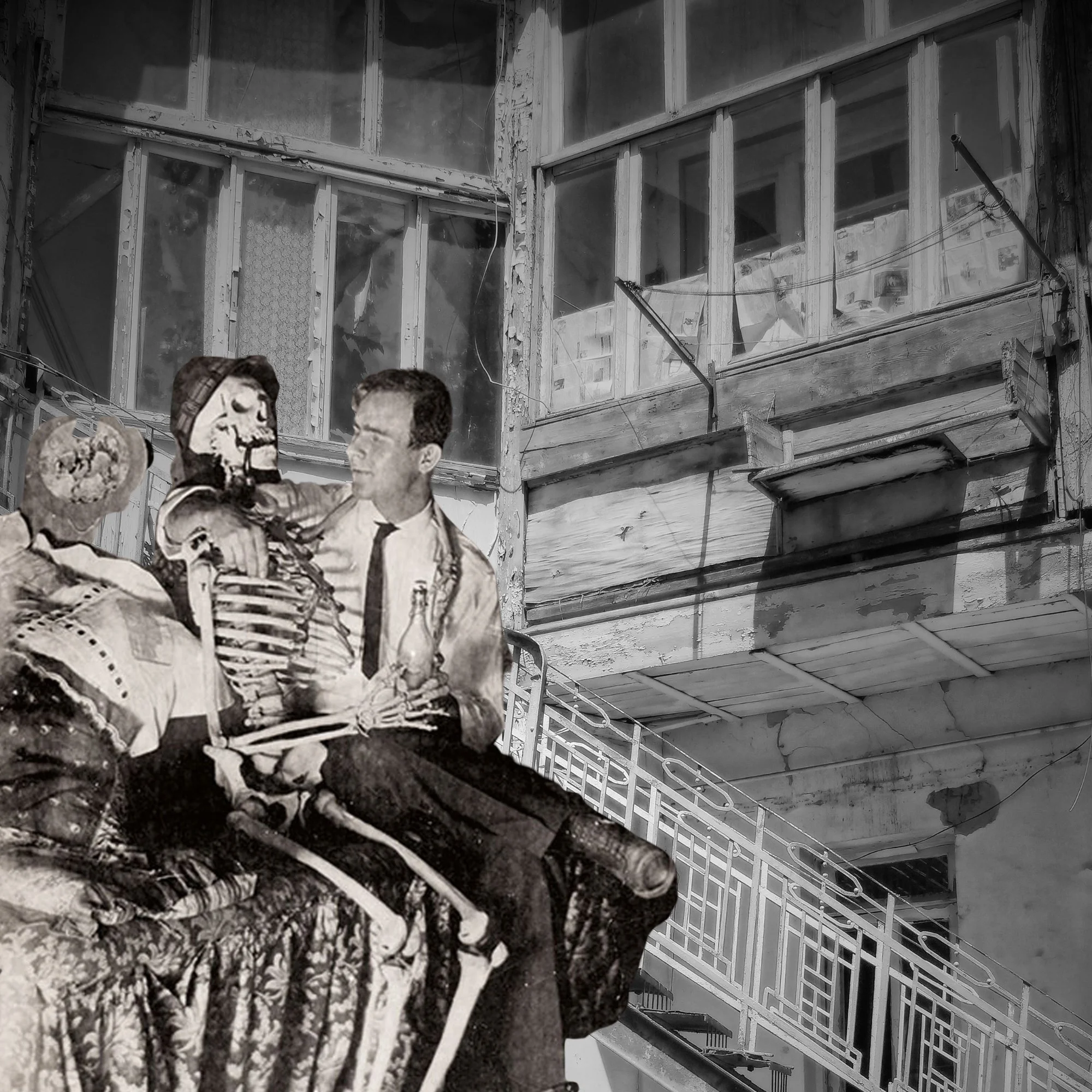
I used to know a woman who would roam the halls of my old apartment complex and threaten to cut herself open from neck to belly button with a utility knife. She wasn’t real, she said. Nothing was. All she wanted, all she needed was for someone to tell her she was wrong. Only then would she truly have an excuse to do it.
Every night after I first moved in, I would press up against my front door and watch her through the peephole as she ambled past. My first thought was that I was the unwitting star of some asshole’s TikTok prank—and you would have thought the same if you’d seen her for yourself: Her explosive blonde hair shot out in all directions, as if she’d been electrocuted; the makeup on her face wasn’t so much applied as it was haphazardly smeared; and the pièce de résistance was her blue one-piece, which made her look like a Grok-generated take on Rosie the Riveter.
But in time I realized that she was just as real as a cold sore. And the more she went on screaming, night after night, the more I wondered why none of my neighbors ever called the police or a mental health crisis hotline. Clearly, something was wrong with her, and it felt sadistic to just watch her suffer through a pupil-sized hole. The way she wailed—like she was being subjected to much worse than a single utility knife—wasn’t just something you could drown out by maxing out the volume on your TV. Although that’s what most of the other tenants did.
I lost count of how many times I had to stop myself from texting Jane about it. She would have known exactly what to do—she was good like that. A true human being. But I always circled back to the same bottom line: It was Jane’s fault that I was living in this cookie-cutter nightmare in the first place. Or maybe it was my fault. Not enough time had passed yet for me to examine the mangled corpse of our breakup with a mortician’s objectivity.
After some basic investigation, I was able to determine that Mary was, in fact, a resident of Cedar Crest. She’d moved into 14B back in 2011—long before I had the misfortune of signing a lease. Mary Ansel was her name. No matter who I asked about her, I received the same who-gives-a-shit shrug. It was like they would rather have talked about anything besides her: colorectal cancer; the Kardashians; blockchains; the inevitable heat death of the universe. Whatever. Anything but the Lynchian side character in the hall.
For a while, I just tried to accept her presence and become one of those people who gets so used to things—even terrible things—that the sudden lack of them would somehow be worse.
But as the months went on and my patience began to spoil, I started to think about telling Mary Ansel that she was wrong. That she was flesh and blood like the rest of us at Cedar Crest. I became increasingly convinced that I, the first person to ever have the gumption to call her bluff, would become a hero among my fellow tenants once I finally proved that she didn’t have it in her. I’d never thought of myself as a brave person, but I’d be lying if I said the prospect of confronting the crazy woman in my hallway didn't make me feel like donning a costume and perching on a skyscraper’s gargoyle against the backdrop of a lightning storm. I could even hear my theme music.
All it took to push me over the edge was one too many homemade cocktails on a lonely Friday night. I could hear her screaming somewhere far off—probably in the common room down the hall. But when I stumbled past my neighbors’ twenty closed doors and flicked on the buzzing fluorescent lights, all that awaited me was our thieving Coca Cola vending machine and the same community bulletin board that hadn’t been refreshed since the late ‘90s. When her distant voice rang out again, I realized it was coming from the floor above—where her apartment was.
After climbing the stairwell, I had just enough time to see her disappear into 14B. It took three unfriendly cop knocks to get her to open the door. Fully prepared for the possibility of being attacked with a utility knife, I assumed an absurd faux fighting stance that only someone as unacquainted with physical combat as me could have pulled off. What made me look even more ridiculous was the fact that I did nothing to stop her as she burst through her doorway and threw her arms around me as if I was her husband who’d just returned from a year-long tour of duty. And I continued to do nothing as she brought her face up to mine and began to search my throat for contraband with her tongue. It had been almost a year since someone had touched me in any sort of intentional way—so what else could I do besides kiss her back?
She didn’t have to try too hard to pull me into her apartment. It was mostly dark inside, but the warm amber glow of the streetlights shining through her windows was bright enough to illuminate the basic shapes of her Spartan setup: a single wooden chair; a love seat; a small table strewn with hardcover books that were missing their sleeves; and a kitchenette piled with dirty dishes. Beyond the immediacy of her hot breath, I could sense the staleness of the place—that dead air smell that greets you when you return from a long absence. Looking back, I should have realized it’s a scent that you can only sense in your own home.
We threw our clothes carelessly on the floor as she led me into her bedroom. This part of her apartment faced north, so the neighborhood bodega’s neon lights painted her walls—and our bare skin—with uneven strips of red, blue, and green. After guiding me to her twin bed and pushing me onto my back, she straddled me, running her fingers over my chest with one hand and reaching over to the nightstand with the other. While I expected to hear the crinkle of a condom wrapper, I instead heard the sound of a cheap plastic click.
The sound of her utility knife blade being revealed. That thing I’d completely forgotten about the moment she first smashed her lips against mine.
Before I could do anything besides gasp and lurch upward, she turned the blade on herself and started cutting downward from the base of her neck. One slow, smooth motion. The sound of the blade slicing through her skin reminded me of a butter knife passing effortlessly through cheesecake. I should have gagged, but instead my mouth filled with saliva and I began to drool. Blood gushed generously from the incision as the blade made its journey past her breastplate. The urge to reach up and dab a bit on my finger hit me like a shot of adrenaline straight to the heart, but she beat me to it and held her wet pinky up to my mouth. The moment the single droplet met my lips, I knew it wasn’t blood. The sweet tang of it made my stomach flush and swirl, danger dancing on the tip of my tongue as I savored the flavor.
Then came a decades-old memory of my father leaning over his beloved 1967 Chevy Impala. It was like I was still standing there next to him, no more than seven or eight years old, watching him intently as he reached down to a small crack in the radiator to swipe up a bit of pink liquid with his pointer finger. He held it out for me to taste, and I thoughtlessly sucked the fingertip dry. “Always a surprise the first time you taste antifreeze,” he said, the heavy skin of his face hanging off his bones like it weighed more than dark matter. “Ain't nothing sweeter.”
I reached up to swipe my own sample from Mary’s fresh wound, but she slapped my hand away and shook her finger at me playfully. Once she finished her incision, stopping at the base of her stomach below her belly button, she tossed the utility knife into a pile of dirty clothes on the floor and began to pry herself open with both hands. Antifreeze was pouring out of her now, pooling in the well of my stomach and streaming down both of my sides. Before long, her bedsheets were soaked, and the entire room smelled like an auto garage.
When I began to tremble with excitement, she sighed in defeat and guided my hands up to her wound so that I could finally reach inside of her. Everything in my life had led up to this moment. My tongue hung partway out my mouth as my fingers explored the muck she was made of: crumpled wet newspaper; half-chewed food in wadded up napkins; plastic bags; broken branches; the tiny bones of dead animals. Staring up into her doll-like eyes, I began to gently pull the garbage from the gaping hole she’d created. She moaned deep and low as I worked. There was more to her than I ever could have imagined. More detritus than the entire complex could produce over the course of a week. It didn’t take long for the entire room to be filled with everything she’d been hiding inside of her. Inconceivable heaps of it. By the time I was through, her body was no longer a body; instead, it was just an empty husk draped over my stomach. Even her head was empty. And yet, she was still able to speak to me in a whisper so soft that it was almost drowned out by the drone of the box fan in the corner of the room.
“See?” was all she said at first. But then she told me to take the utility knife and cut into the wall. It was still sitting atop her heap of clothes, its bright orange handle standing out amongst the geological layers of trash strewn about the room. I picked it up and approached the wall, ignoring how the drying antifreeze was causing the insides of my legs to stick together as I walked. Just like Mary’s skin, the wall subtly squelched as I cut through it—like it was made of nothing but thick grocery store frosting. Top to bottom, then across, then top to bottom again—I made myself my very own doorway into the neighboring apartment. Using my hands, I tore at the fragile material until it crumbled and slopped onto the floor. Waiting for me in his living room was Charlie, an elderly widow who would bring candy canes to every resident of the complex on the first day of December. He didn’t budge as I approached him, just kept his eyes trained on the Star Trek rerun that was playing out on his ancient tube TV.
“Do it,” Mary whispered from where I’d left her on the bed.
I gently lifted his chin so that I could look into his eyes. Besides my own tiny reflection in the glossy black of his pupils, there wasn’t much there. No fear. No confusion. No willingness to fight what I was about to do to him. He was nothing but a doll in my hands. With just a simple pinch and pull, I removed the only two remaining tufts of white hair that grew above either of his ears. Rubbing them between my fingers, I realized it was all merely cotton. His unkempt eyebrows and mustache were no different. Once I’d completely ridded his head of the fake hair, I brought the utility knife up to the center of his forehead and began to slice downward. His skin—which I came to realize in that moment was faux beige suede—was a bit more difficult to cut through than Mary’s; it caught at times—especially when the blade traveled down the crooked arc of his misshapen nose that bent slightly to the right. I was also surprised when spoiled molasses started to ooze from the incision instead of antifreeze. Earthy, putrid, and almost too thick to drip all the way down Charlie’s face. By the time I’d cut all the way down to the bottom of his stubbled chin, the blade was caked with the stuff. I’d need to wash it before I moved on to my next project—but that could wait. For the moment, I placed the blade on the armrest of Charlie’s chair and started to peel his face back with my dirty fingers. Instead of muscles, I found rotten slabs of liverwurst haphazardly layered atop a skull-shaped chunk of styrofoam. It didn’t take much effort for me to break it all apart and scatter it across the room. Looking back into the bedroom through the fresh doorway I’d made, I could faintly see Mary's husk staring emotionlessly at Charlie’s now-headless body.
“What are you waiting for?” she whispered.
Still naked, I slowly began to cut my way through the rest of the Cedar Crest apartment complex. No one objected as I entered their homes and performed my little surgeries, and there was no end to the variety of waste I yanked free from their bodies: moldy silly string; handfuls of dead cockroaches; plastic bags filled with snot rags and crusted old diapers. By morning, every last one of my neighbors was nothing but an emptied skin suit—the same as Mary. The complex itself looked like wood that had been tunneled through by a single hungry termite. Walls and doors made of Play-Doh, tofu, and honeycomb—none of it had stood a chance against Mary’s utility knife.
Standing in the entryway and staring out at my little corner of Cable Street as the morning sun cast its long shadows across the concrete, I watched cars sitting idly on the road, their drivers paused halfway to their destinations. Hands on the wheel, expressions as stoic as wax statues. At the foot of the stairs below me was a kid who'd been riding his bike—now he just stood there straddling it, eyes trained forward the same as the people in their cars. Piss streamed down his legs, staining his jeans. Above me, a county lineman hung by a strap from a power line pole, motionless, arms dangling at his sides. Sparks spit and popped from the transformer he’d been working on.
“Keep going,” Mary’s husk whispered. I’d draped her around my neck like a shawl, so I could feel her cold breath against my cheek as she spoke.
Not knowing what else to do besides obey, I started to make my way through the neighborhood, ridding everyone I could find of the trash that filled their elaborate costumes. Then I moved through the others: Dinkytown; The Warehouse District; Prospect Park; King Field. Eventually, the entire city was nothing but a sprawling landfill.
Would you believe me if I told you that I took Mary’s utility knife to the rest of the entire world? That I didn’t stop until only garbage and husks remained across all continents? That I eventually rebuilt everything—and everyone—all over again once there was nothing left to slice open? I started with Jane, taking care to ensure that she was just as selfless and beautiful as before. I even rebuilt Mary—but this time I gave her a husband and a baby to fuss over. They’re a sweet little family, and you're god damn right they make you smile as you walk past them in the cereal aisle.
Out of all that nothing came everything you take for granted. I bet you had no idea who you’re talking to. Who I really am. You probably just thought I’m some degenerate who pointlessly wanders the halls and doesn’t know when to shut up.
Don’t make me do it. I’ll do it. I’d love to do it. All I have to do is cut myself open and you’ll see the truth.
Anthony Lien is a writer/editor who lives in the Northwoods of Minnesota. If he isn't writing, reading, recording music, or spending time with family, he's probably outside talking to crows and trading them almonds for cool trinkets. His work has been published in Bruiser Mag, Maudlin House, and Apocalypse Confidential.