
Float
by Jenna McClain
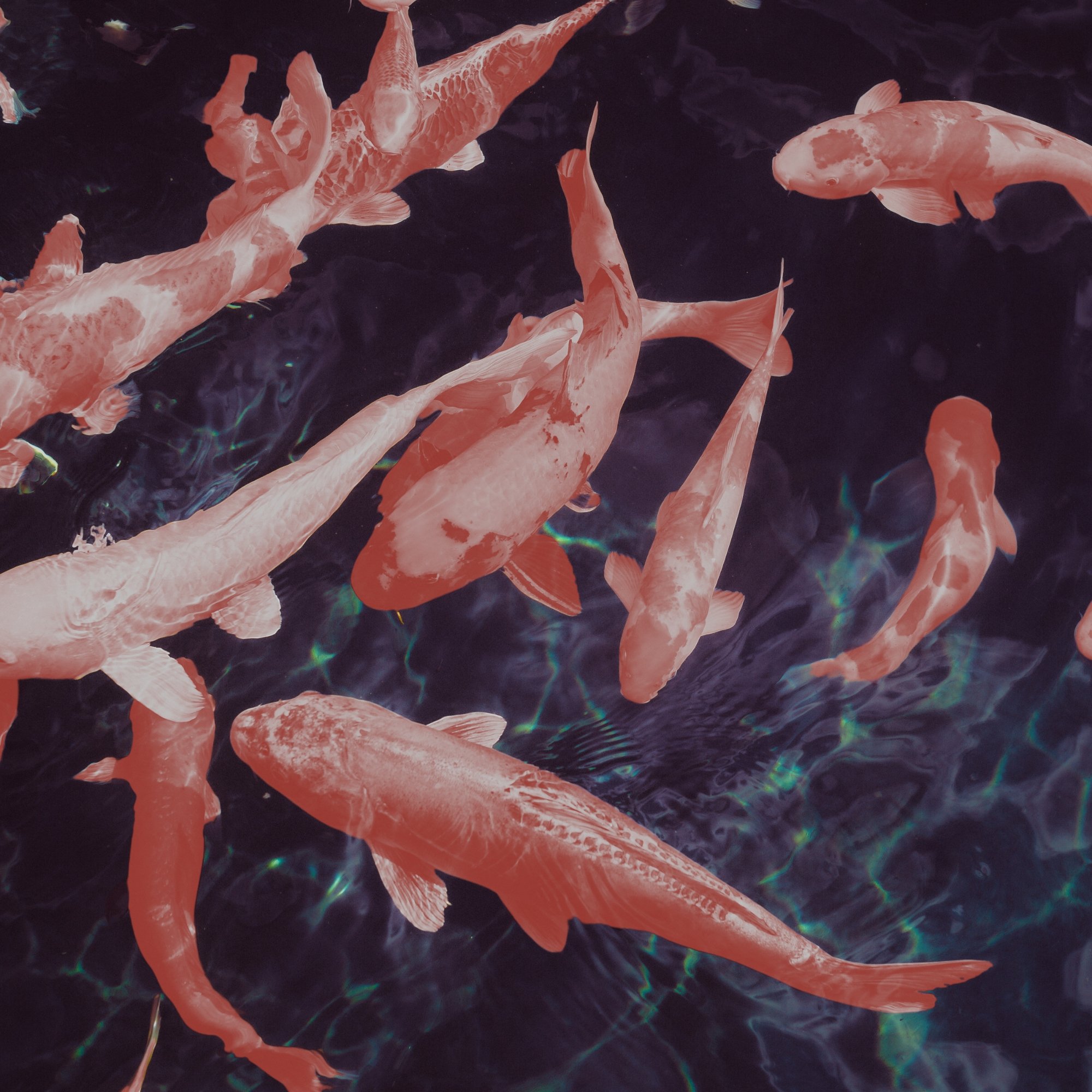
Mr. Miyagi’s koi fish are mouthing at my toes.
The worst one, a big orange and black thing with a tail as long as my hand, had my entire pinky toe in its mouth before I realized and kicked it away.
They’re getting bolder as the hours go by. The light through the kitchen window dims, the water gets a few inches higher, and the traitorous things discover that their tank is getting a whole lot bigger. I can’t find their original habitat and wonder where the hell Miyagi kept them before this.
I shout when one gets especially feisty and bites down too hard. “Friendly,” Mr. Miyagi says by way of explanation. He goes back to furiously clicking the remote at the TV. I don’t know why he tries. The power went out days ago.
***
I was in Marisha’s apartment, then, a couple floors down, sitting in her dining room while the water soaked the hems of my jeans. Her leggings were saturated but she’d still bothered to apply blush that morning. I’d fixated on it, the unnatural flush of her cheeks, and wondered how long it took. To stand before a mirror, rub the bristles of a brush through pigmented powder and drag it carefully across the apples of her cheeks. I was getting to the part where she dabs the color on the tip of her upturned nose when the chandelier sputtered and blinked out. We both jumped; instinctually, I reached across the gameboard to grab at her wrist and check for a pulse. Electrocution doesn’t pick and choose, but I wasn’t focused on the logistics.
She excused herself from our game of checkers, played on a chess board because she had nothing else and neither of us were taught the true game, and never came back to the table. I wondered why she was alone, why her parents with stay-at-home blog writing jobs weren’t sitting through to the end with her. I thought about asking, then didn’t. I wouldn’t have wanted anyone to ask, either.
I found Marisha face down in the bathroom. There was a plastic hairbrush floating in the water next to her busted head, a smear of red on the edge of the sink. I shut the door and could almost imagine she wasn’t in there, as long as I didn’t pay attention to the especially opaque water on that end of the hallway.
I stayed in her apartment until the water got too high because she had canned goods and tall beds and lots of dry books on high shelves, and then when the water reached the wall-hung family photos in the entryway, I moved on in search of another generous neighbor.
Mr. Miyagi’s apartment is the only unit on the top floor, the one everybody refuses when they move in because the water pressure is ass and the balcony doors don’t open. When I knocked on the front door he let me in, apparently because nobody else had thought to knock yet. Everyone but me forgot he was up here, tucked away.
“Good job not drowning,” he said, unphased by the gush of water forced into the foyer by breaking the barrier between the wood and the hallway. “Come in.”
In the days I stay with Mr. Miyagi, the flood slows. Does not stop, can’t stop, won’t stop now that it’s begun and the streets are gone and the first four stories of every building within view of Mr. Miyagi’s bedroom window are subaquatic. But it’s trickled down enough to give everyone ample time to appreciate how royally fucked they are.
***
We create a kind of rapport as the water comes in through the gaps. I open tuna cans with a Swiss Army Knife like Marisha taught me, and Mr. Miyagi regales me with stories of people I don’t know and he doesn’t care to properly describe. I can tell it’s been a while since the guy spoke to anyone apart from his fish, and I have nowhere else to go. I become the fish.
The koi have switched to attacking a plastic fern floating in the kitchen. For a moment, I know peace.
“Is that your real name?” I ask. “Mr. Miyagi? Like, from those karate movies?”
“What? Shut up. Not all Asians like karate.”
“That’s not what I—”
The TV remote smacks my left arm, splashes into the murky water. Ripples dance across the top and dissipate against my sweater sleeve. The yarn used to be cream. Now I’ll drown in shades of brown.
“Hush,” Mr. Miyagi says.
“I haven’t said anything.”
“I can hear you think.” He taps hard at his salt and pepper temple with an unnaturally shriveled finger. “Big, dumb, karate thoughts.”
Funny thing, really, that the longer you spend in water the more it dehydrates you. Sucks anything useful right through your pores. Osmosis, equalization, what goes in must come out, except when it’s in everything and covering everything and abandoned Mini Coopers float by your balcony doors. It’s a red one, this time, with two thick stripes across the hood. There’s a humanoid form in the front seat. I choose to ignore it in favor of hoping the car doesn’t hit the glass.
“It was just a question.”
The orange and black koi is back. It goes for the dead skin on my knuckles.
The car inches closer. The water’s not clear, but it’s clear enough. The body inside the car hits the windshield.
***
“Where is your mother?”
Mr. Miyagi isn’t looking at me. I drill my gaze into the side of his wrinkled face, hoping he’ll feel bad for the overstep. Maybe my stare will poke holes in his cheeks. The water will seep in, counteract the buoyancy of inflated lungs, and it’ll only be me left on the top floor. We’re wasting air, anyway, having both of us in Mr. Miyagi’s shag carpeted living room. It’s not as if we can open a window.
“She was at work.” Probably bobbed right out of it when the tide reached her basement cubicle. Might be somewhere in the bay by now. Or pressed up against the ceiling tiles, trapped by the pressure. Her and her coworkers, ice cubes floating at the top of a glass. Or they’ve all sunk, the water oversaturated, solute and detritus settling at the bottom. Who knows.
“Pretty lady. A shame.” Mr. Miyagi used to bring my mom gifts; red bean pastries, well-tended bamboo sprouts in clay pots. Once, a painting of the bastard black and orange koi. I only knew where to find his apartment because mom forced me to deliver him Thank You cookies last Christmas. I asked her why we should thank a creepy old guy for never leaving us alone. She said his issue was that he was alone.
“You’re not going to screw my mom.”
“No one is, now.”
“Ew.”
“She reminds me of my daughter.”
“And you still want to screw her?”
“No one wants to screw anyone. Karate, screwing. Always jumping to conclusions.”
I don’t notice the water has lifted me off the couch until my foot hits the armrest. Instinct hooks me, a tug behind the navel, an itch to survive I thought I lost when I swam out of Marisha’s place and up the choked-off stairwell. I throw my ankles back and forth to keep the water at chest height. “Forgive me if my patience is wearing thin.”
I’ve got a foot in height on Mr. Miyagi. The water’s grazing his chin. He’s probably standing on the back of an arm-chair but it’s too dark to tell. The sun’s setting, I think. I remember my fifth grade science lesson on water displacement, how shoving a ping pong ball into a full cup made the liquid spill over the edges because it took up the water’s space. The sun is bullying its way below, a gaseous ping pong ball squashed beneath the horizon, forcing the water level above Mr. Miyagi’s box television.
“Impossible for patience to wear thin with such a fat head.”
“If you hate me so much, why did you open the door?”
“I heard you knock. Hoped it would be your mother.”
***
“Where’s your daughter?”
The living room is dark, save for rare moonlight that breaks through as the water laps at the windows. Another day gone and another foot lost. Any higher and the old panes will give. I wonder if there’s anyone else in this city, in any city, also waiting for the rate of structural collapse to decide when it’s their time to go. Perhaps we’re especially lucky.
“New Orleans.”
“Louisiana?”
“No, Antarctica. Mardi Gras in fur parkas is very fun. And the penguins love the shiny beads.”
I offer nothing but a blank face.
“Yes, Louisiana. Obviously. This is why you float so well. That big skull is full of air.”
Half of Louisiana is below sea level, which means Louisiana hasn’t been Louisiana since that first day. I think about newsreels from Hurricane Katrina, historic mausoleums busted open by flooding. That pesky water displacement—none may escape—forced the coffins right out their gated archways, elevated caskets that had been safe beneath the sodden ground or within exquisite marble casing, and sent them bobbing down the road.
Louisiana is a mausoleum. Mr. Miyagi’s daughter is an ornate box, displaced. Mr. Miyagi coughs. “I am no fool.”
“Did I say you were one?”
“I know my daughter is dead.”
“So she really is like my mother.”
Mr. Miyagi seems to consider this. I can’t tell for sure, because he’s floating on his back after having run out of things tall enough to stand on, and all I can make out in the dark is the curve of his nose. But he’s quiet for a long time, and I was taught that silence before speaking means careful contemplation.
“Almost like your mother,” Mr. Miyagi says finally.
“Oh yeah?”
“Yes. Except…”
I wait, anticipating, hanging on every word, because the only image of my mother I can conjure is the one of her leaving for work days ago and never coming back. If Mr. Miyagi can tell me something about her I don’t already know, it will be like she’s still out there. Some version of her, even if it’s not my own. Because it’ll be one I haven’t seen, so how can I prove it doesn’t exist? I’ve never been much of a skeptic.
“My daughter was never a mother. Makes a difference, that does.”
Entirely unhelpful. No kid imagines their mother as anything else other than their mother, which means I surely never did. But it doesn’t matter now, because my mother isn’t anything anymore. Like Marisha on the bathroom floor isn’t Marisha playing checkers, and Mr. Miyagi’s daughter isn’t his daughter if she’s too busy drifting out to sea. No one is anyone during times like this.
I decide to pick and choose which parts of my mother to keep alive. It’s a patchwork quilt of lined eyes and harsh words and peanut butter sandwiches with the crust cut off, and I pretend it’s enough to keep me warm.
***
I don’t realize I’ve fallen asleep until I’m waking up.
I’m still on top of Mr. Miyagi’s breakfast bar; I’d discovered that if I backed up against the wall and stood on the microwave, it kept the lapping water from splashing into my mouth.
The general degree of misery I’ve felt over the last few days has come to a peak. My tongue is sandpaper. There’s a good chance I’m floating in my own piss. I can’t stop shivering—this water has gotten cold. If I’m young, able-bodied and this miserable, I can’t imagine how Mr. Miyagi is feeling.
“Hey,” I shout across the room, unable to see clearly despite the increase in daylight. “Miyagi? How we doing?’’
There’s no response. Just the bubble and churn of water forcing its way in through the cracks.
“Mr. Miyagi, can you hear me?”
Sacrificing the safety of the microwave, I step off and paddle with whatever energy I have left. It takes me an embarrassing amount of time to round the corner of the kitchen and into the room beyond, and when I do, I’m so startled that I lose focus and start sinking.
Flashing movement across the room, a dozen little splashes and the glimmer of sleek bodies shooting through the water. I think I’m scaring them. Coins in a fountain, a thousand wishes that never come true, wasted pocket change and valuable time. Miyagi’s koi fish, scattering in all directions.
It’s much, much easier to swim when my veins are stinging in my wrists. Searing, burning dread. “Mr. Miyagi, c’mon, this isn’t funny.”
A golden dollar coin, valuable and useless and ornate and cumbersome, circles Mr. Miyagi. I stay far enough away to catch nothing but his silver hair poking above the surface, the fabric of a dress shirt stuck to his motionless back.
I don’t know how long I was asleep. Mr. Miyagi’s hands are bloated.
The half dollar circles once more, makes a mad dash for Miyagi as if getting a final taste, and skitters away. Then it passes me, slowly, as if checking to make sure I don’t also have lungs full of water. Black and gold, black and gold, like a godly bruise. The koi rejoins its friend group by the hallway.
***
It takes me half a day to reach the roof. The deadbolt on Miyagi’s door busts in, the multi-thousand gallons of water pressure is too much for the old joints, and I’m able to slip into the darkened hall. I think some of the koi follow me out, but the water is so full of other debris I can’t be sure it’s not something else.
The stairwell is open, thick door thrown aside, dinged metal hanging partially off its hinges. I wonder vaguely if someone had the same idea as me and end up fighting a shamefully brief internal battle regarding whether I’d be okay running into another tenant. Miyagi is back in his apartment, unless his loyal pets drag him elsewhere. Marisha is still in her bathroom, right next to that hairbrush. The plastic of it will last forever, ready for use, unlike the prone form that drifts beside it.
No. I am not okay facing another tenant.
The raw daylight shocks me when I reach the roof. I’ve grown so used to seeing it through grimy windows or from the guts of a shadowed dining room that feeling it directly on my crumpled skin burns, salt in a wound I’d started to ignore after spending so long letting it fester.
Once the pain recedes I step farther into the light. I’m startled by the noise of it; there’s a distinct lack of splashing water as I fall to my knees in the gravel. The blunt force is a relief. The now paper-thin skin of my knees tears and I’d cry in relief, in the sheer joy of feeling, if I wasn’t thinking about who was going to feed the koi fish when Mr. Miyagi is nothing but bones.
Born and raised in Indiana, Jenna McClain spent most of her younger years staring at corn fields and cranking out works of fiction on the family computer. She holds a B.S. in Economics from Murray State University. Her writing has appeared in JMWW and Twin Flame Literary.
Find her on Instagram @jenna.mcclain