
Bass Line
by Peter Geier
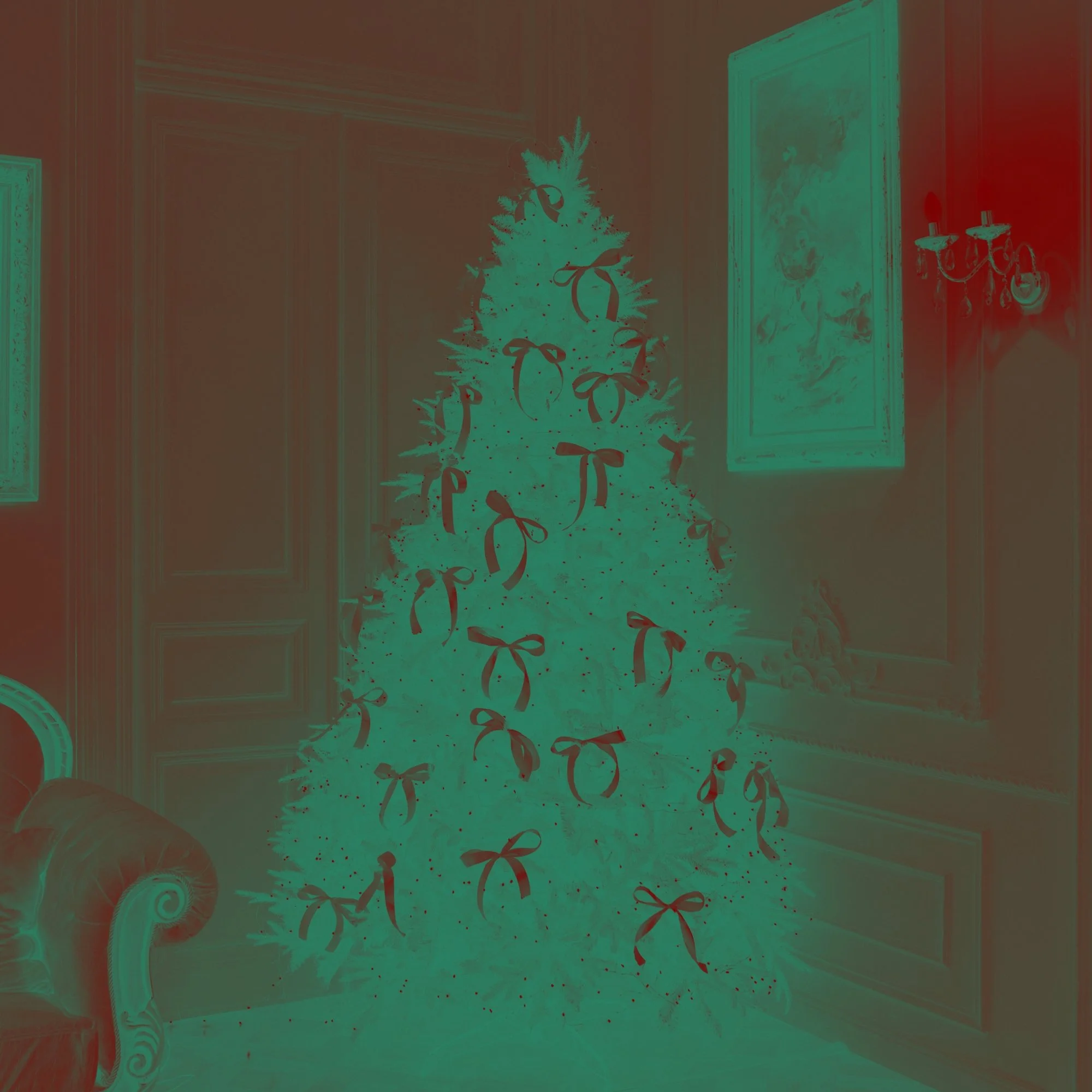
Lean back and coax yourself into a mood. Before long you wind up low-crawling through tinsel hanging on the bottom boughs of a Christmas tree at Sissi von Seidenfelder’s annual goddamn holiday gala.
Well, that was how things shook out, the whole Christmas spirit and what-have-you and most everyone in the room just laughing. None of them would have pulled a stunt like that and their laughter sounded uncomfortable. Laughing at others usually is: I mean, there but for the grace of God, right? My drinking had nothing to do with it. Anyway, a scotch or two is hardly what I call drinking. Standing around nursing drinks, making polite small talk in a blazer, tie and plaids with everyone else decked out the same, doing the same thing—hell, the moment was ripe for somebody to give it a whirl. The hardwood paneling, prints of ducks and hunting scenes, Early American controlled intimacy: You get the picture.
So on I went, making a hole through designer-wrapped gifts as I low-crawled. On the other side I met a curious cat sitting upright, her head cocked sideways, lightly boxing at a tinsel-tangled bough my motion had jiggled. A manly “Bravo!” resounded as I emerged—a real three-pointer—and I damn near went right the hell back under the tree to camp on pine needles. It was warm down there and the light was just right. But getting a good view of the shindig at shoe level gave me the giddy-up I needed to deal with it at eye level. Somebody handed me a fresh drink when I came out. I may have started out with a word like “de-eligibilization” in mind but that has too many syl-labbles. In any case, I lost my original train of thought under the tree. It was just as well. Another train would come. My idea was to loosen things up a little and I guess I did: No one was dancing on the tabletops yet but the cat was the only one so far to run off.
I went to help hold down the bar at the far end of the main room. I pictured myself in the afterglow a character in a white dinner jacket at a fashionably disreputable night trap in an old movie, lighting an unfiltered cigarette with a drink in hand, looking over the house. I wondered if I’d brought anyone under the tree with me. The early returns weren’t promising but it may have been too early to project a winner. The evening was getting on. Time to circulate.
There clearly were some sharp-looking babes in the room. My eye wandered to a brunette I didn’t know, looking as though she were all ears for what some dried-up parsnip with his back to me was saying. There may have been a nibble of interest but it swam away.
Ernie Whitman, a former college roommate, was winking at me theatrically from across the room. He was talking with friends and starting to glow a little. Ernie never would have gone under the tree, even if you’d offered him a nice chunk of change and thrown in seven houris. His issue was The Little Woman, that is, his wife Mavis, the very graven image of “No!” It didn’t surprise me that Mavis never took much of a shine to me. But I never was able to work out whether it was because she had zero sense of humor or was just wrapped too tight to appreciate the breathing holes life’s little pratfalls and ironies give us. Whatever it was, Mavis had a fresh kibosh ready to slap on whenever Ernie started to show even trace amounts of having a good time. She was like one of those old-fashioned Christmas candies you get from a zany aunt: It looks great in the wrapper but ends up tasting like beef jerky when your eye told your tongue there was sugar on the way.
Mavis had her head together with some old school chums, undoubtedly attitudinizing over the suitability and unsuitability of members of the present company.
Well, well, well: Ex marks the spot.
“Didn’t take you long to get oiled now, did it?”
“Here’s looking at you too, Sweetcheeks,” I said, raising and draining my glass.
This was the magnificent Charlene, my ex-wife and love of my life. It’s hard for me now to recall what got us in the same church at the same hour on the same day surrounded by families and friends. It’s easier to see that it didn’t take long before we barely could stand the sight of each other and soon were living at opposite ends of town. Life’s like that. It could have had something to do with Charlene’s dad Thad. The thing is, Charlene and I still love each other, we just can’t paddle the same canoe. There probably are no two better-suited people more unsuited to each other than the two of us. I suppose that goes to show that romance is not dead.
Charlene looked fantastic from where I was standing. She always did wherever she was, and her eyes were twinkling, some might say with malice; but then those some do not know my Charlene.
“So what have you been up to, Sweetcheeks?”
“Keeping busy. I see you’ve got a little cutie over there giving you the eye.”
“What? Oh! You mean the brunette. Know her?”
“Uh-uh. Think I’d introduce you if I did?”
“You could give me a two-thumbs-up testimonial.”
“Ah-hah.”
And what could I say to that? This time around I was determined to duck out in my burnoose under a good head of steam so I changed the topic.
“Looks like Israel and the Palestinians are really going to go for it this time, so let’s let bygones be bygones and take the next dance on the tabletops.”
“Huh?”
“You know, like trip the light fantastic toe table topside?
The Palestinian business may have caught her off balance, but what the hell, it was topical and the first thing that popped into my head. People talk about stuff like that at these do’s, like the latest political shenanigans or foreign crisis, pundits, pundints, how many dead white guys you can fire from the canon—all that hoo-haw.
“Sorry. Dance card’s full. You haven’t met David yet.”
“David?”—she gave me the look—“Oh yeah, right, David. Sure, of course.”
It seemed at the time as though every woman I knew either was interested in, or seeing, or engaged to some nincompoop named David—reverent, both syllables, no Dave’s need apply. This led me to suspect that this David business had to be a female rite of passage because they all seem to end up marrying Bills, maybe a Steve or Larry now and then. I am partial to the seeing part because what meets the eye just gets things going. Would I see more if I changed my name? Probably not: That would be just to scribble a new address on an old brown paper-wrapped package-store package. I could get by fine without the David thing but the Bill route had not worked out so hot for me either. I got stuck with Clarence, a cross-eyed lion in grade school that even shortened to Clary or spelled with a “k” was still a far, faint cry from “Bond—James Bond.” Of course, without the snazzy accent, Saville Row tailor, Aston-Martin DB-5, and license to kill, a James Bond could be just as easily some Baltimore shoe clerk or a pump jockey in West Bumfuck Junction.
The brunette’s interest had not swum back. Before I had more time to bottom feed, my heart’s delight was back with her David in tow. I was thinking “Goliath.” She introduced us.
“Pleased to meet you Clary. That was some stunt you pulled back there,” David said, squeezing my hand and vigorously pumping my arm.
“You ought to kick the tires and take it out for a spin sometime. It’s great for the reflexes, the lower lumbar, does wonders for one’s perspective, and stops on a dime. A little thing I picked up in the service.”
Color, feeling, and circulation slowly worked their way back to my fingers.
“Ho! Ho! Ho! Charlene here’s told me a lot about you”—I could just imagine—“and I can see you more than fit the bill. In the service, were you? Which branch? In the war? It’s an out-standing experience, out-standing! Which branch did you say?”—I didn’t—“Of course, I was never in the service myself”—of course—“MBA right out of school, much too busy with other things. So what do you do now?”
“Me? Oh, I’m a PI for AP in DC, a tech rep. I service accounts, crunch numbers, cook books, and launder the petty cash”—I could feel those magnificent green eyes rolling even though I couldn’t see them—“you know, like, shoot the crimson to Jimson full count, bases loaded two down, bottom of the ninth, my club up by two sort of thing. Fast-paced? Hell yes, it’s fast-paced. But that’s what keeps us A-number-one, ‘top of the heap, king of the hill’ as the song goes, ahead of the curve, on the cutting edge of our chairs, outside the box. What’s your angle?”
“Hmm, yes… Interesting… Impressive… Umm, well, it’s clear that—Oh! Charlene, look: the Organ-Morgans just arrived. We have to… Excuse us, Clary. Nice meeting you,” David said, grimacing and forgetting to shake my hand as he tore themselves away.
As I started out saying, lean back and coax yourself into a mood.
But to get back to Charlene’s dad. The problem there was more hers than mine, for I met Thad just once and we’d hit it off like the Irish and their Guinness. Thad liked that I had done my thesis on the ninth century Iranian warlord Ya’qub ibn Laith. He liked it even more when I added that despite what they tell you, mention of that and a couple of bucks is liable to get your ass tossed out of most places that serve coffee.
Thad had studied the Middle East at Princeton and Cambridge and then went into the military as an officer and was stationed first in Iran. He changed posts several times, making colonel before crossing over to a civilian government job doing roughly the same thing, some kind of intelligence work. He left government after twenty years and went to work for a mom-and-pop oil company. You would have thought that coming from his background and connections, the family, Episcopalian schooling, Princeton and Cambridge, the military and then the foreign service, would have groomed him for the serious big time. Not Thad.
The family has owned an enormous tract of nowhere in the Nevada desert since the nineteenth century. At some point, Thad’s idea of the Middle East stopped fitting into his surroundings and he decided that he had enough of working for other people. He retired to Nevada to lead the quiet life of a territorial tribal shaykh. He lived in tents and kept on the move, hunted with falcons, bred camels, and raised sheep. He sat around long evenings with cronies and servants he had managed somehow to import, all smoking Lucky Strike cigarettes, telling stories, looking like a sepia print of a long ago era. He did not come to our wedding because though he loves his daughter, he has no patience for what he calls “kiss-ass gridlock under glass.” Thad and his tribe had no internet, no television, no radio; precious little put them in the twentieth century besides the odd plastic household item: a red plastic bowl here, a clear plastic measuring cup there, a blue jerry can for water, and pocket-rounded soft packets of Luckies. They had an ancient gray Land Rover with a c-b radio for emergencies and trips to town. From the look of things when Charlene took me out to meet him, none of them seemed the least aware or curious that they were a lot closer to the fleshpots of Las Vegas and Los Angeles than Aleppo and Damascus. It was without doubt one wild pack of cards and not a one for any shoe in Vegas.
Whatever Thad was up to, it took me no time at all to see that he was a whip and for real. He had a great sense of humor and, despite appearances, the way he lived made perfect sense for him and did not take me much getting used to. Charlene was relieved and pleased at first by my easy acceptance of her dad’s eccentricities; she became more apprehensive the more often I brought him into our conversation and suggested that we spend more time with him. I mean, despite the lengths Thad went to, you really had to hand it to the guy: He didn’t just make a good point, he lived it.
I wouldn’t give Charlene’s David project an old-time missionary’s chance among cannibals out there. They’d just as soon wind up stoning a nitwit like that for something or other, maybe just for his own good or to keep limber. And it requires no great leap of the imagination to guess that this is exactly what Charlene sees in him.
To give you an idea of life in Thad’s Nevada caliphate, I’ll share a story I heard about him from a local cop.
A couple of snowbirds we’ll call Dean and Edna, newly retired, were seeing the Great American West for the first time from the bridge of their fully-equipped recreational vehicle. They were navigating the southwest in high summer, headed for “Vegas” thinking slots, blackjack and floor shows, comped hotels and meals. They hit a stretch of flat highway through a Biblical wilderness with nothing to see for miles around; in other words, the Great Nevada Desert. Every now and then they’d pull over on a highway shoulder, a rest area if there was one, stretch their legs, use the restroom, have a cold drink.
At one such stop, Edna thought that she saw something move on the far horizon. Dean got out the binoculars. This moving something resolved into a rider which became a man on a dromedary camel. They would not have known that this man was dressed in the full regalia of the Al-Murrah tribe of the Bedouin but saw that he was armed to the teeth. This was Thad. But it made for an apparition no less astonishing to Dean and Edna than Omar Sharif’s Ali was to Peter O’Toole’s T. E. Lawrence, as Sharif’s Ali materialized from the shimmering wastes of Arabia Deserta when the two first met in the movie “Lawrence of Arabia.”
Dean supposed that someone was making a movie.
When the mounted Arabian knight came within range he drew to a dignified halt. He leveled a long-barreled, medieval-looking firearm in their direction and with a sonorous “Boom!” put a large ball across the bow of the recreational vehicle. Then he was away, like a djinn. Likewise Dean and Edna. Convinced that they had survived a close encounter with The Islamic State, they never tired of retelling the story: “I sure wished we’d got his picture!”
Thad had similar encounters before and after. He never hit anything or hurt anyone. Because his family owned land in this area since before the territory was a state, and the local authorities share roughly the same view of out-of-state snowbirds, the sheriff’s department dutifully take down tourists’ complaints in incident reports. Afterward they chuckled and chalked these up to Thad’s being a good ol’ boy and left it at that. Thad no doubt charmed them. But best of all is that his private umma is a vast tract they never have to worry about.
Hell, someone in Vermont would probably do the same damn thing if they thought they could get away with it. You wouldn’t have to look far afield to find a game middle-aged guy in camo and face paint with a crossbow. But a Vermonter would sooner open a shop to scalp tourists of their cash.
In any case it all just goes to show: Lean back and coax yourself into a mood and damn near anything can happen.
Peter Geier has reported courts and written features for local, national, and international news publications. He has independently published a variety of fiction and nonfiction pieces, including humor and speculative fiction and an anthologized story on a trip to a Turkish house of delight. He recently finished “Border Town Capriccio: An Epic in Twenty Short Chapters.”