
In Milkspace
by Steven Cline
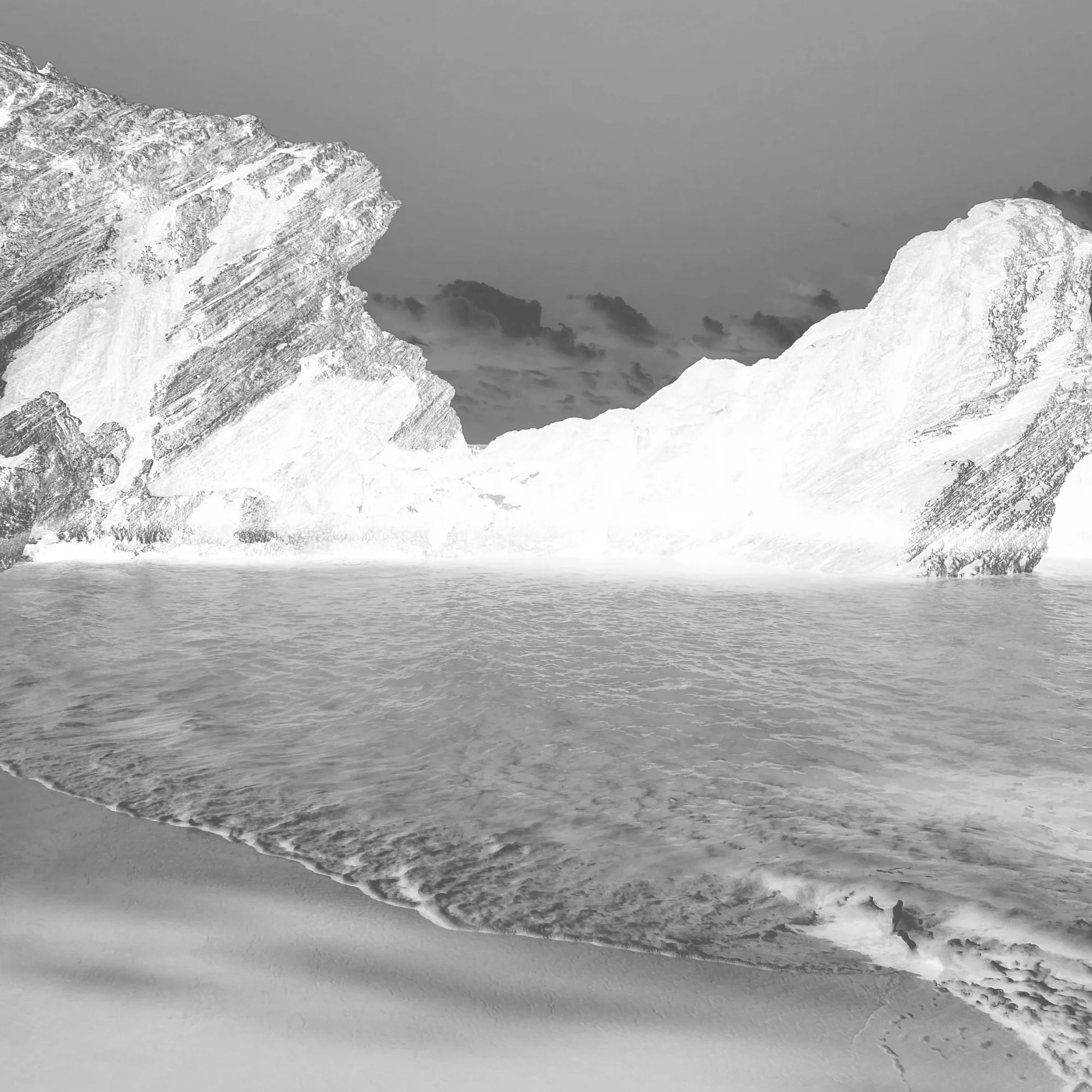
I begin to exist. This is the first time.
A steam surrounds my body, blocking my vision. It dissipates.
I notice the walls. I look left, right. All is smooth and shiny. White. Like frozen milk, cascading down, caught in an action which never ends. Milk? I don’t know what that is. And yet, it seems the proper word. Though I say frozen, the walls are not cold. Instead, they are slightly warm.
I feel a weird shiver of joy at being alive. I grab the sides of my hole and pull myself out. Hole…shallow grave? Something like that, my unmemory decides.
I stand up on the glassy, still-white ground. I look, I turn in a circle. All is white, everywhere. And there is a clean grid of graves surrounding me. About two or three feet deep, with little, gentle people in them. Their bodies are milky, flowing and shifting. Alive. And yet this flowing liquid still retains a general form. A form called humanoid. That’s the word my mind retrieves, anyway.
I drift along the grid lines, wondering. Does it go on forever? I continue walking. The sky is dark. And yet all is illuminated.
I walk, and walk, and walk. My longest life experience thus far. Is this everything there is? The joy of the walk? Of the one foot moving in front of the other? In time, I see the pleasure in it. The wisdom. To move, to change space. To occupy one space in time, and then another entirely. What strange, mischievous fun!
And yet as soon as I’ve decided this is it, that this is what it’s all about, I reach a shoreline. I see an ocean of vast milk. It is the obscene inversion of all that I’ve known. And I hate it.
Solids, gone liquid. Waves crashing, angry, foaming. It is like me, in a way. And yet endless. Endless and unformed. Unembodied. As though they drilled deep holes in millions of others like me, and then let us all drain out, mixing together, becoming one, without skin. I shudder, and feel a tightness in my chest. I start to back away.
I certainly don’t want that. But I also feel a certain something floating up in me, now. A kind of black and weighty stone. A vague dissatisfaction. This view of the ocean has changed me, removed my weightless innocence. Perhaps there’s a half measure out there? Perhaps If I wake up another like me, this stone will lose its bite?
I wander towards the nearest grave. Look down into their closed, snowy eyelids. Kiss first the left one, and then the right. Whiteness opens into whiteness. Two circular mouths stretch up into a smile. I teach the Other to stretch its new, fragile legs. Teach it to grab tightly at each side of its grave-wall, and pull itself out.
“A thousand thank-yous, my friend, for this most fine and terrible wakefulness.”
“A thousand welcomes in return, O brother in moisture.”
“And what is this land, pray tell. An icebox? A northern pole? My memory is splintered, but these words do seem to float up, and a few others.”
“Your guess as wise as mine. Yet I know this: there is a bad place ahead. Wet and wild. Mysterious. I call it Old Ocean.”
“Images and words rise in me. Is it a place of great dampness, and of drowning?”
“It is.”
“Perhaps we should view the beast together. Decide what is to be done.”
“Let us, yes.”
I grow anxious as I near the vastness. I begin to sweat, to lose little parts of myself. This scattering of myself into the warm ground terrifies me further still. Could I lose all of myself in this way? If I continue in this way, what then? Will there be a single drop left?
Before I can calculate the rate of droppage, and my probable time still remaining, we reach the ocean’s edge. It is the same as before. As it always has been and always will be, probably. I don’t like it any more than I had before. Less, even. But my partner seems enamored with it. He is running up and down the shoreline, laughing and giggling. For a moment, he almost touches the cascading milkfoam, and then runs away again. Mere inches from a toe. A bizarre, reckless game.
“What are you doing? If you merge like that, you’ll be nothing!”
“Or I’ll be everything! Who’s to say?”
I sit down on the beach, distraught. I’ve only just met this partner, and already he is threatening to leave me. To join the unthinking ocean—to let his body be dismembered by its waves. I can’t believe it. I close my eyes as tightly as I can, and begin to hum. A soft and gentle song. A song without a name.
But my song isn’t loud enough.
Through it, I can still hear that dreadful splash.
And then—the silence.
I open my eyes. There is no one.
Just me, and the ocean. And the sky.
I think of waking up others.
But I know that the outcome will always be the same.
They’ll leave me. I’ll remain.
Only one path is open: to escape this place. But how? How can I cross an infinite ocean? As if in response to my desire—and to my pain—a wing begins to pull itself from my back. It is drawn outward, as though sucked free by an unseen force. Soon, I can see it. I can move it. A soft, marvelous wing of liquid silver. I test it, and it works.
I rise. I fly up and down the beach. I fly over my brother’s graves, too. All is well. All is still. When they wake, I’ll be long gone. And I can make it across the old ocean. I know that I can.
I take one last look at the graves. I turn my brave eyes to the horizon. I fly.
* * *
Three days into my flight, the sun is drowned in thick milk.
A sudden, unexpected bleaching, a white eclipse.
My wingtips melt in the afterglow and then fail.
As I see the ocean’s infinite mouth rushing up to greet me, I think—
Steven Cline is based in Atlanta and has been involved in surrealist activity for the past decade, including Peculiar Mormyrid Journal and the Atlanta Surrealist Group. He has co-organized exhibitions in Atlanta and Birmingham and has participated in others in Paris. His first book of fiction, Planetoid Sassafras, was published by Montag Press under the name Stephanie Klein. A subsequent book of surrealist nonfiction, AMOK, was published by Trapart Press.