
SADOCHRISTIANISM
by Matías Bragagnolo
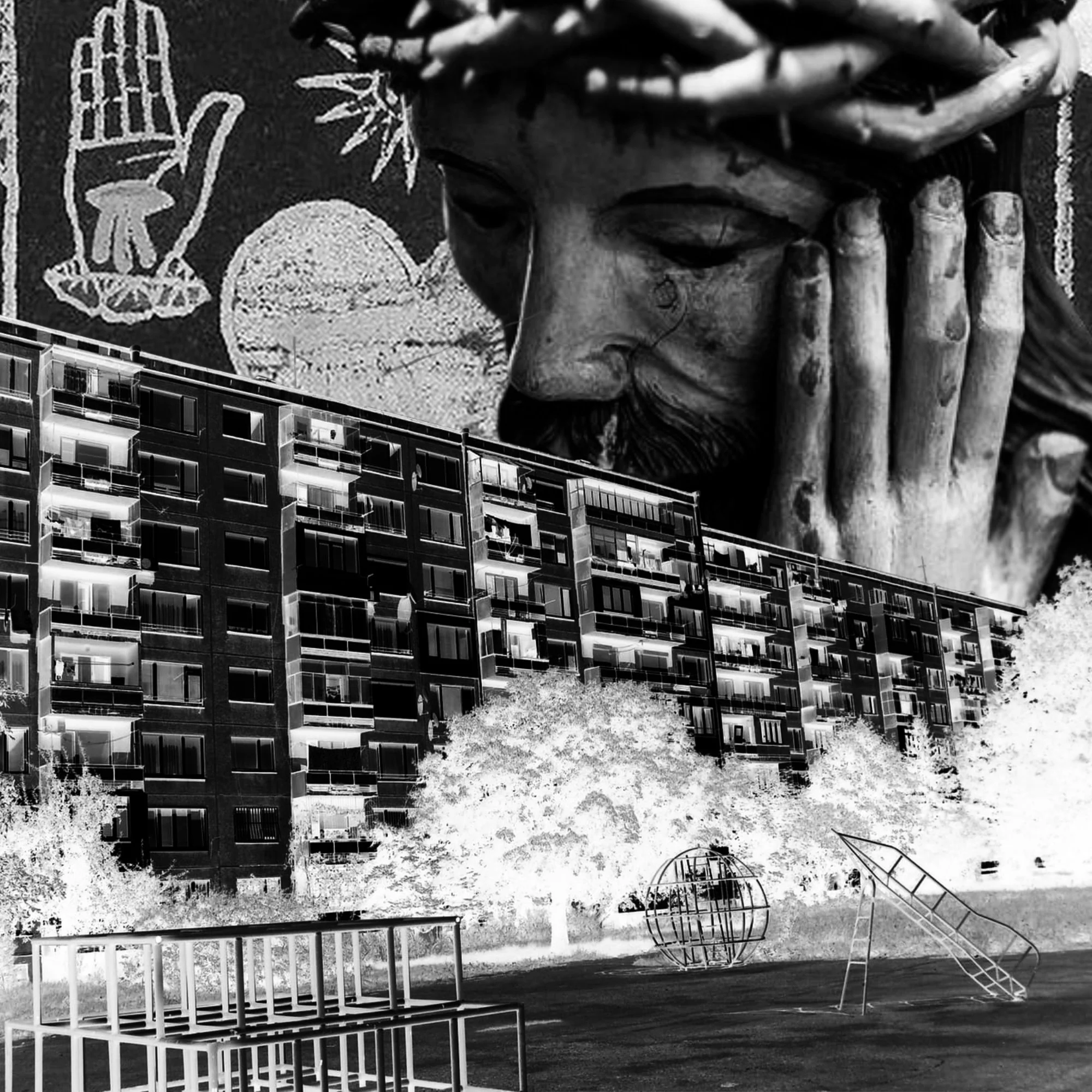
“I'm Jesus Christ. Whether you accept it or not, I don't care!”
- Charles Manson
Men get an erection when they are hanged. In fact, most of these erections are accompanied by ejaculations. Therefore, each of these condemned men experience an orgasm.
It has also been confirmed that people who die by burning have an orgasm in the last moment of life. The final pleasure, amidst the flames.
* * *
In a governorate of the Russian Empire called Bessarabia, more precisely in the city of Kishinev (now known as Chișinău), between 1974 and 1985, serial killer Vasili Solovki convinced 33 teenage boys to participate in sexual acts that included hanging and ended with the victims being burned to death.
Solovki made each young man he seduced stand on a chair. He then fastened a noose around the neck of the youngster. Without giving rise to the erotic foreplay the victim assumed would take place, the killer kicked the chair over and clung to the hanged boy’s torso in a close embrace, kissing him and rubbing himself. As they both swung in the air, Solovki ejaculated.
It was usual that when the unfortunate teenager was taken down from the improvised gallows, he would still be alive. That didn't stop Vasili, who had already placed him in a bathtub and was dousing him with liquid fuel. Thus, most of his victims, although unconscious, were burned alive.
* * *
In the early days of September 1250, in the courtyard of a house in the Jewish quarter of Zaragoza, a huge black dog, having escaped from its home, howled incessantly by the well. It was supposedly a dry well, which the Jewish family had been forced to abandon years before. Someone told the very old and respected rabbi who owned the house that it was the dog of the notary Sancho de Val.
But the mastiff defended itself with bites and refused to leave the place.
When they knock on the door of the house in the San Miguel neighborhood, both the notary and his wife get happy. Dominguito, the family's eldest son, has been missing for days. They fear the worst, of course, but hope is something that is never lost. To the rabbi’s family’s dismay, when Val’s couple arrive and are led into the courtyard, the water that the well was lacking has risen to the edge of the stone curb.
Floating on the surface, everyone present can see Dominguito’s severed head, hands, and feet. His mother does not hesitate to take in her hands the congested and pale head of blond hair, the same one that seven years earlier had been born with marks of thorns on its forehead and temples.
A halo of will-o’-the-wisps appears that same night on the banks of the Ebro. They float over the water. At times they disappear, but they remain intermittent until dawn, when the guards of the pontoon bridge go to the town hall to report the situation. They’re not supposed to portend anything bad, they’re the fires Saint Elmo uses from the sky to guide lost sailors, but you never know. It would be a bad idea to have to deal with the Holy Inquisition for failing to report what could very well be the result of acts of black magic.
A delegation of public officials arrives that same night with their torches to draw up a report in case the fires recur.
The fires are once again hovering over the waters, but what most worries those present is the disturbed earth on the riverbank, near the section of the river where the phenomenon is occurring. Which is, perhaps not so coincidentally, meters from the place where the Virgin Mary appeared, standing on a marble pillar, to the apostle James the Greater on January 2, 40 AD.
They decide to dig, especially considering that they still haven't been able to find the rest of the de Val boy’s body.
The corpse of the seven-year-old boy, without hands, feet, and head, was indeed buried there. Inside a bloody cloth sack.
When a pilgrimage passed by the door of the house of a Jew named Mosé Albayucet, a moneylender by profession, the following week, he could not help but go mad when he saw the relics being carried in the air, exposed to the sun and flies.
Tearing his hair out and throwing himself on his knees in the midst of the Christian faithful, he kept shouting that he wanted to be baptized, that he was repentant, that he wanted to die by hanging. “The little dead’s gaze haunts me, sleep has fled from my eyes.”
* * *
It is said that the best orgasm is the one experienced when dying from asphyxiation. The techniques are varied, but the person must reach orgasm, either through interpersonal sex or masturbation, while simultaneously being suffocated by a bag or hanged. And while it is claimed that this is the best orgasm a human can achieve, no one could say for sure if this is true. Resuscitation techniques have been attempted in various laboratories, but they have not yielded the expected results: for the orgasm to be extreme, the person must actually die.
* * *
Vasili Solovki was born in Ukraine in 1943. The man he had always considered his father abandoned him and his mother in 1947 after hearing a confession from his wife, having just moved to Russia. The truth about Vasili’s fatherhood corroborated the doubts of his father, who had been conscripted to fight in World War II since 1941. Vasili was not his son. His wife had been raped by German soldiers during a raid by the Wehrmacht’s ground forces. This also explained the mental imbalances the woman had been exhibiting recently.
After being abandoned, Vasili’s mother struggled to support her son financially. They were living in a boarding house room when, at a neighborhood fair, the woman bought him the only gift the boy would remember as an adult: a rubber doll of an anthropomorphic mouse marketed under the name Topo Gigio, a very popular toy at the time in Italy.
Her mother's fixation with the inert gift was the trigger that led to her institutionalization. She claimed that all the noises heard in her room at night—including laughter, whispers, objects moving on their own, and a foul odor so strong it woke her—were caused by Topo Gigio.
When the boarding house dog was found dead with marks on its neck, Vasili’s mother didn't hesitate to accuse Topo Gigio. The boy, afraid that his mother would throw away his favorite toy, hid it in a gutter.
This made matters worse, because the unfortunate woman became convinced that Topo Gigio had escaped, and from then on, she attributed every misfortune she learned of to the mouse.
The final straw came when mother and son witnessed a fatal traffic accident on a public road. A young drunk motorcyclist crashed into a truck and was thrown from his vehicle with such force that his head passed between two streetlight cables and, unconscious, he was left hanging by his jaw for a few seconds before falling to the concrete of the public road and breaking his neck.
This turned out to be the first of the episodes that would shape little Vasili’s future sexuality. Not only because of the effect the image of the teenage motorcyclist dangling for seconds from that electric cable would have on his psyche, but also because his mother’s immediate psychotic episode confined him to a state orphanage until adulthood.
(. . .)
Life in the orphanage was hard, and in particular the discovery of masturbation. The wardens were especially cruel to the boys, beating them to a pulp for the slightest infraction. One of them, who worked at the institute during Vasili’s adolescence, used to spend the night shift knitting with wool while supervising the sleep of the institutionalized minors. She seemed to derive intense pleasure from interrupting the boys’ vices under the sheets. She would tiptoe up to the bed and, without warning, plunge her long, thick needles into the poor, pubescent body, paying particular attention to the buttocks and pelvis.
* * *
Recent scientific-theological studies proclaim the sadomasochistic preferences of our Savior. They claim that for centuries the orgasm Jesus Christ experienced while dying on the cross was hidden under the word “ecstasy.” According to these scientists, the entire so-called passion and death of Jesus was an event of liberating pleasure for a Messiah who during his life had oscillated between celibacy, covert homosexuality, and sadomasochistic role-playing. Among the conclusions reached by this group of heretical scholars, a key point for understanding their hypotheses is their reconstruction of the torture and death of our Lord Jesus Christ.
* * *
One Saturday in February 1250, after finishing the reading from the Babylonian Talmud, the most venerated and respected of the rabbis, the oldest, interrupted the service to make a request to all those present that evening in that synagogue in Zaragoza.
“Passover is approaching. We need Christian blood to celebrate it. Jehovah will not tolerate our negligence much longer. Let’s throw a consecrated host and a human heart, a Christian one, into the river. In this way, all worshippers of Christ will die when they drink the water.”
Gold can do anything, and that's something not only Jews have known since time immemorial. Salt could provide jerky and prevent the leftover meat from a freshly slaughtered animal from rotting, but gold had always been more attractive. That’s why they had bought the faith of an old woman with gold, who agreed to pretend to take communion and escape from a mass with a host in her mouth. For his part, a hungry beggar had promised them the heart of a Christian child in exchange for a few coins of vile metal.
The host had been duly consecrated, of that no one had any doubt. But a pig’s heart is too similar to a human heart, and the fact that the beggar had deceived them became clear when, after throwing the two precious objects into the Ebro river, instead of Christians dying, a plague claimed the lives of all the city’s swineherds.
This time the old rabbi's anger was devastating. The proposal he made to his community was tempting: “Whoever brings me a Christian child will be exempt from paying the temple tax for life. We will use his blood to knead the matzah[1].”
The moneylender Mosé Albayucet left the synagogue that night filled with enthusiasm. The possibility of winning the prize the rabbi had promised would be on his mind for months. Apparently, he was the only one of the Jews present who had taken the old man’s words seriously.
* * *
When Vasili Solovki wasn’t hanging around bars and clubs looking for gay boys, he was engaged in prolonged sessions of solitary sadomasochism. He found particular pleasure in mortifying himself with needles and nails. He would insert needles into his pelvic area, use nails to pierce his stretched scrotum and leave it nailed to a table for hours.
(. . .)
According to the medical record kept at the Police Museum of the Ministry of Security of the Bessarabia Oblast, on May 17, 1981, Solovki was admitted to the emergency room of the Timofei Moșneaga Clinical Hospital with a high temperature, an increased number of white blood cells, and severe swelling in his left arm, after having injected his own semen intramuscularly. According to what can be read in his diary, injecting semen intravenously was a common practice in those days, but everything seems to indicate that he mistakenly injected the sperm into muscle tissue, and this led to the abscess that left him hospitalized and flying with fever for several weeks.
* * *
The betrayal of Judas Iscariot was never fully explained in biblical texts, but everything seems to indicate that it was not due to demonic possession. The man who appears in the third verse of chapter 22 of the Gospel according to Saint Luke is what would commonly be called a third party in discord. That is, a dominant homosexual with whom Judas allegedly cheated on his Master Jesus Christ (in whose “harem” he served). The Satan who entered Judas through an incubus (or a succubus, assuming the traitor was active) was only a simple human, a Jewish high priest, or perhaps a scribe, to be more precise. Hence, it is possible that Judas, seduced by his lover, agreed to betray his Lord for thirty denarii.
* * *
In the first week of September 1986, Vasili Solovki met Alexandr and Nikolai Fastenk in a bar, an incestuous couple who were looking for homosexuals to have sexual threesomes. Father and son, well-off financially, didn’t hesitate to pay if the night of hunting turned complicated. What they didn't realize was that, on that evening, they were the ones being hunted.
(. . .)
The murders of Alexander and Nikolai Fastenk were the only ones that Vasili Solovki did not carry out for pleasure. Everything he saw in those two eccentrics’ house made him want to steal, and it was the second time in his life he'd experienced that. The first time had been when he saw Topo Gigio at that fair, before crying for his mother to buy it for him.
Upon entering the mansion’s enormous living room, the visitor was confronted by a life-size statue of a squalid black woman, reclining on her haunches on the floor. From the hand of the arm bent and resting on its elbow hung a human head shrunken by Jivaros, held by its hair, which tangled in those contracted stone fingers. And that was only the beginning of the works of art, exotic souvenirs, and relics that father and son had acquired on their travels around the world.
Solovki confesses in his diary that the object that made him decide to kill the incestuous couple and stay living in the house, without answering the phone or the door, using the service door to go out to work, was the enormous rusty nail that both of them swore was one of the nails from the cross of Christ.
* * *
Every morning Dominguito del Val walked at dawn from his house to the cathedral, where he served as an altar boy and member of the choir. After morning mass, he would go down to the cloister, where after practicing his voice with the precentor, he would join the group of children who, like him, were learning to read and write, to add and subtract, writing on parchments that they placed on wooden tablets.
That Wednesday, August 31, 1250, he left the cathedral later than expected, when the shadows of dusk were already falling. That afternoon he was alone; his companions had returned home hours earlier. He had no one with whom to spend the walk rehearsing the liturgical hymns they had learned that morning.
He felt afraid as he entered the aljama, the Jewish quarter. The shops were already closed at that hour, the alleys were too narrow, and the houses were too tall. The darkness of that hour had deepened from one moment to the next in that gloomy sector of the city.
Despite his state of alertness while walking, he did not hear Mosé Albayucet approaching from behind, who with one hand grabbed him by the neck and with the other wrapped his head in a cloak. In a matter of seconds, Dominguito was inside Albayucet’s house, gagged and tied up.
* * *
The Last Supper could well have resulted in a Dionysian orgy, but there is no documentary evidence of this, not even in the Dead Sea Scrolls. The truth is that, once Christ was handed over to the Jews, an extended session of sadomasochism worthy of a sexual dungeon began. The social and religious nature of the trial carried out against Jesus Christ is not questioned, we only affirm the sexual characteristic of the flagellatory ecstasy of the incessantly accused and finally condemned Lamb of God.
* * *
The first of the consequences that Vasili Solovki attributes to the practice of masturbation with the nail of the cross of Christ partially inserted into his urethra is the spontaneous loss, due to necrosis, of his foreskin. In fact, throughout his diary he refers to the supposed changes he witnesses in his body as “metamorphosis.” He does not even classify the supposedly spontaneous wounds he claims to have experienced on his hands and feet as stigmata.
(. . .)
In the entry for December 22 details:
This morning, without even leaving the master bedroom bed, I raised my right hand, exposed it to the light coming through the window, and a thin ray of sunlight pierced it. While it was something I’d been looking forward to for weeks, I was thrilled to be able to slide the index finger of my other hand through the wound. To dig it into my bloody palm and watch it slowly emerge on the other side.
* * *
Mosé Albayucet transported the boy that same night. He didn't have to go far into the Jewish quarter. Just meters from his home, in the mansion of the most venerated and respected of the rabbis, a mock jury of the Holy Office was waiting for him. A dozen rabbis were preparing to desecrate and mock the trials with which the Inquisition had taken the lives and dignity of more than one of them.
They removed Dominguito's gag and blindfold. Standing before his judges, still dressed in the red cassock and the rochet he had worn that morning to the cathedral, he heard the first question. Did he wish to remain an acolyte of Christ, or was he willing to renounce that bastard?
With tears in his eyes he replied with the only answer he had to give.
Seeing the cross hanging on his chest, one of the rabbis promised him freedom if he threw it to the ground and trampled on it.
The refusals to renounce his faith followed one after another, and the patience of the rabbis was not that of the inquisitors.
They brought the ladder, the hammer, and the nails. They gagged the boy again and, without even undressing him, raised him against the wall. One nail in one wrist, another in the other. With a third eight-inch nail, they nailed both feet. On his head they placed a crown of thorns, specially made for the occasion from bramble stems.
While Dominguito’s body convulsed with pain, they made an incision with a knife simulating Jesus Christ’s spear wound. They collected the blood in jars to make matzah.
* * *
Once Barabbas was pardoned, the prefect Pilate ordered the King of the Jews to be flogged. This time, the sadomasochistic King was a slave, perhaps the most lashed slave in the universal history of sex. He even enjoyed a crown of thorns embedded in his head and a red cloak. He also had a whipping session that would delight any ruthless master and any good slave. Jesus Christ was insulted and spat upon by the soldiers until they were exhausted. But none of the Gospels mention him complaining.
Did he joyfully carry out the order to carry the cross to that skull-shaped hill called Golgotha? Probably. Did he enjoy the nails driving into his limbs? Everything seems to indicate that this was when the pain momentarily ceased to be pleasurable and became unbearable (see his exclamation, “Eli, Eli, lema sabachthani!”). From this moment on, Christ could no longer be held responsible for the orgasm he suffered upon dying (expressed in the final cry that St. Mark mentions, St. John omits, and St. Matthew and St. Luke reduce to a phrase with which the dying man commends his spirit), since all his consciousness must have been lost in the state of shock into which he undoubtedly fell. The ejaculation resulting from orgasmic ecstasy seems to be confirmed by what is expressed in the Gospel of St. John when, instead of breaking his legs as they had done to hasten the death of the other two crucified criminals, one of the soldiers pierces one of his flanks with a spear, blood and water flowing from the wound.
* * *
Vasili Solovki stated in his diary that he had acquired the ability to experience lucid dreams. That is, the ability to observe dreams in a semi-conscious state. He detailed in one of his notebooks how he had spent several months teaching his mind to “recall in reverse,” a procedure of an esoteric nature that supposedly enabled him to recall his dreams in detail. By his own admission, he achieved his best masturbations while setting fire to his victims, but those he practiced while reliving his erotic dreams were even more intense.
In the notebook covering the months between September 24, 1985, and January 5, 1986, the erotic dream that revealed to Vasili the “genetic contamination” that the nail from the cross of Jesus Christ had caused in his body during the days he kept it inserted into his penis is recorded. This dream presumably occurred before he experienced the first of the symptoms.
The details of the dream can be found in the entry for October 8:
I wake up and look around me, lying down. A candle in a corner of the spacious wooden box that serves as a coffin illuminates us.
Jesus Christ lies to my right, naked in that small, suffocating space. Overcome by claustrophobia, my desire awakens when I discover that no bandage covers his body, nor does any artificial perfume contaminate the oppressive atmosphere.
I press myself against the sacred corpse and stroke its hair, its thorn-scarred forehead, its beard, its closed eyes, its cracked lips filled with parables and dried vinegar, its bruised shoulder, its torso embroidered with lashes, its chest, the dry wound, its swollen belly covered with greenish stains, its knees full of coagulated blood. Christ stripped of his Word-iness. When I insert my fingers into his stigmata, my arousal is complete. I whisper horribly into one of his bloody ears: panis sacratus in altari, salva sua substantia, est corpus Christi. Space is limited, but for the moment it is enough for my intentions prior to the satisfaction that the erection in my groin demands.
The first thing I bite into is one of his shoulders. I sink my teeth into those muscles barely freed from rigor mortis and tear into the marbled flesh of the Lamb of God with unholy appetite. A watery mucus-like fluid hangs from my lips as I chew the sweet, gummy, strong fiber. It doesn't taste like pork or chicken as I had imagined. It doesn’t have the warmth I expected. It just tastes like consubstantiation.
I grab him by the hair and bite his neck. When I pull away my mouthful of skin and only a little flesh, my hand moves away from his head without me having to open my fingers. The lock of hair has come loose.
I chew quickly, and when I swallow for the second time I throw myself on the spear wound and suck it with relish, making it enormous, squeezing with my lips and tongue all that soft mucus that flows from the Savior's flesh.
I persist until my passion forces me to seize one of his hands and bite down on the fingers. I don’t care how hard the bones are, I only try to tear the rotten flesh off the two or three that have entered my mouth.
Then he opens his eyes. It's obviously the Third Day. Bad timing for a resurrection.
He tries to breathe, opens his mouth, and his chest begins to rise and fall. I know that if he starts screaming, I won't get another chance; I’ll be stoned.
I spit into the palm of my hand and lubricate my erect penis. I spread his legs, lift his scrotum with my left hand, and position the glans against his anus. I’m already on top of him, covering his mouth as it craves the little air we have left.
And with a single thrust I possess Christ, I possess him as if nothing else mattered in life, as if the threat of apocatastasis no longer existed and we were the last two people in the world.
(. . .)
On March 28, 1986, Good Friday, Vasili Solovki met a teenage prostitute named Ilya Grigorievich in the Kishinov train station restroom. For 800 rubles, the young man agreed to accompany him to the Fastenkos’ house and carry out the demanding sadomasochist's instructions.
Everything went well until it was time to stab and drag the edge of a kitchen knife under Vasili’s right nipple, following a line he had drawn with a marker between two ribs. Ilia, realizing the consequences of this last act, panicked and ran away from the house. Two days later, on Sunday the 30th, he turned himself in to the police.
* * *
If we are able, with regard to the existence of Jesus Christ, to affirm that the event of the crucifixion, unlike the supposed miracles performed and his resurrection, really took place in the High Roman Empire, where is the scientific explanation for bleeding containing water? Considering that, to achieve greater humiliation, Christ had been stripped of the scanty clothing with which he is usually represented on the cross, it would be more plausible to argue that blood and semen, or, to put it more hygienically, the residue of his orgasm, fell from his disciplined naked body.
* * *
The bones of Dominguito de Val rest in an alabaster urn inside the chapel that bears his name in Zaragoza Cathedral. Standing over the relics, a copper angel holds a banner with the legend “Here lies the blessed Domingo de Val, child martyr for the name of Christ.”
* * *
The fact that Vasili Solovki’s body was discovered immediately after Easter 1986, thanks to the spontaneous confession of the only accomplice to the self-immolation, generated a certain collective local psychosis, which only served to rekindle the anti-Semitic sentiments once preached by the Black Hundreds.
As a historical review, it is worth recalling the “Blood Libels,” a saga of medieval legends that began and had their profusion and epicenter in Spain, later spreading throughout Europe, similar to the panic over satanic ritual abuse that began with the McMartin family daycare center case in the United States in 1983.
When the case of a certain Dominguito de Val, the first child martyr of the Blood Libels, was followed two centuries later by the kidnapping and crucifixion of another Christian child in Valladolid, the myth of ritual sacrifices carried out by the Jews during Holy Week, the date on which this second crime took place, was set in motion. In affront to the dogma of transubstantiation, a minor was murdered by crucifixion, and his blood was used to produce the unleavened bread of Passover. Two years after the Valladolid case, a new infanticide took place, also on Good Friday, in a village belonging to the Marquis of Almarza, near Zamora. Before the end of the 15th century, two similar deaths followed, one in Sepúlveda and another in La Guardia, in the province of La Mancha. When Holy Week passed without any dead children, it was said that the Jews, faced with the factual impossibility of kidnapping one, had made a wax statue and crucified it.
The first documented case in Russia of ritual murders involving children crucified by Jews was that of the Ukrainian boy Mikhail Rybachenko, in April 1903, in the village of Dubăsari, Kherson Governorate. The crime was reported to the public by a widely circulated anti-Semitic newspaper published in Kishinev (40 kilometers north of Dubăsari).
The response of the Black Hundreds (the oldest fascist organization in Europe) was not long in coming. On April 19, as soon as the Easter masses ended, the pogrom began in Kishinev. Led by Catholic priests, the hordes swept through the city for two days, leaving a trail of dead in the streets by the evening of the second. Not even babies were spared, while the police and city authorities looked the other way. Nearly fifty Jews were murdered, while nearly a hundred survived with serious injuries. The community’s homes, some seven hundred in number, were looted and vandalized, as were six hundred commercial shops.
When a second child crucifixion occurred in Russia in 1911, in Kiev, fortunately, public attitudes changed. While they did not hesitate to accuse a Jewish businessman, Mendel Beilis, of the ritual crime, they guaranteed him a fair trial. A jury composed of Christians found him innocent two years later.
The fact that Vasili Solovki had long since ceased to be a child was of little concern to public opinion in the 1980s. Fortunately, this had no major consequences: as a result of a second pogrom in 1905, there were no longer any inhabitants of Jewish origin in Kishinev.
As already hinted, when the police entered the home of Alexander and Nikolai Fastenko, they found Vasili lifeless, naked, and crucified against the north wall of the living room.
A crown made of twisted barbed wire was nailed to his shaved skull. Lines of dried blood divided his pale head into irregular strips.
In accordance with the instructions he had given Ilya Grigorievich, the nails holding his arms against the living room wall had been driven into his wrists. Solovki knew that the stigmata holes in his hands would be of no use: the “dead” weight of the human body would have torn through bone and flesh immediately.
Under semi-flexed knees, a third nail pierced both feet, positioned one on top of the other.
At the base of the penis there was a thick rubber ring, undoubtedly used by Solovki to prolong an erection. Thanks to this ring, the penis still maintained a semi-erect state at the time of the raid. The blood, lodged in the cavernous vessels during the ecstasy of crucifixion due to the compression at the base of the penis and the upright position of the corpse, had been unable to return to the rest of the body, remaining there until it coagulated. During the autopsy, the forensic doctors were forced to cut the ring, so great was the pressure the swollen penis exerted on the rubber band.
(. . .)
Grigorievich’s spontaneous confession at the police station in the Rîșcani district, as seen in the previous chapter, put paid to the possibility of a murder of that nature, at least if his words were to be believed.
(. . .)
A preliminary inventory of items collected from the house by forensic investigators was recorded in local police report No. 32654/86. According to it, the police removed the following items that day:
- Glass jar containing a rusty nail in formaldehyde
- Portion of dried, twisted human skin, held in a clasp similar to those used to preserve dried portions of umbilical cords of babies [later biopsy determined that it was the Solovki’s foreskin]
- 60 milliliter syringe with a built-in 150 millimeter hypodermic needle [it is estimated that this is the syringe with which Solovki punctured his bladder to evacuate his urine when he used the nail of the cross of Christ inserted into his urethra]
- Sledge hammer with traces of blood
- 8-inch nails, 3 with traces of blood and some human tissue
- Black leather whip
- Cat-o’-nine-tails with lead balls (contains traces of blood)
- Cat-o’-nine-tails with metal claws (contains traces of blood)
- Topo Gigio rubber doll.
“The only thing that makes reality is death. Then they hang it on a cross and kneel down and pray to it.”
- Charles Manson
[1] Unleavened bread, that is, without yeast. The official food of Pesach, the Jewish Easter.
Bibliographic References:
“Blood libels: infanticide in Spanish anti-Semitic folklore”, Pierre Domenach, Éditions Goncourt,Vichy, 1983
“The not so petite mort, or the ontological relations between agony and ecstasy”, Rebecca Cappelletti y Katherine Coschug-Toates, in No-Mental Land, monthly magazine of the Institute of Paraphilia Studies, XVIII, Nº 148, pp. 8-14, Newcastle, 1994
“Crucified: Inside the Mind of Russia's Most Depraved Killer”, Julian Conrad, True Current Crime Press, Oxford, 1998
“Death, Flesh and Pleasure of Jesus Christ: An Anthropological-Sexual Essay”, Robert Manitoba, Friesen Publishing Group, Ontario, 2002
Matías Bragagnolo, Argentinian, is the author of the novels Petite Mort, El brujo, La balada de Constanza y Valentino, El destino de las cosas últimas, Dormiré cuando esté muerto, and Cloacina. He’s a scholar of the work of William S. Burroughs and the cut-up technique, and a researcher and essayist on matters related to rock, literature, and cinema. His novella The Fate of Last Things has just been published by Anxiety Press.